

What to Look for in a SaaS Billing Platform
Before the picks, a quick frame for the category. The phrase “credit card processor” gets used loosely in the SaaS world, and the tools below sort into two related but distinct buckets:
- Payment processors / gateways — Stripe, Braintree, Adyen. These move card transactions through the rails (Visa, Mastercard, Amex, etc.) and handle PCI-compliant tokenization. They charge per transaction.
- Subscription billing platforms — Chargebee, Recurly, Maxio (formerly Chargify), Stax Bill (formerly FuseBill), Zoho Billing. These sit on top of one or more processors and handle plan logic, proration, dunning, revenue recognition, and tax. They typically charge a percentage of revenue plus a platform fee.
Some tools (Stripe Billing, Braintree) span both layers. Others (MemberMouse, MoonClerk, WooCommerce) are checkout/membership tools that integrate with a processor underneath.
When evaluating, focus on the dimensions that matter for recurring SaaS revenue:
- Failed-payment recovery (dunning). Card declines, expirations, and 3-D Secure fallouts make up most involuntary churn. The platform should retry intelligently, send branded reminders, and update card details automatically through network tokenization where supported.
- PCI DSS compliance. The current standard is PCI DSS 4.0 (mandatory since March 2024). Hosted fields, redirect-style checkouts, and payment links keep cardholder data out of your environment and reduce audit scope. If you’re also working through SOC 2 compliance, the billing platform’s own audit reports (SOC 2 Type II, ISO 27001) become part of your vendor due diligence.
- Strong Customer Authentication (SCA). If you bill EU/UK customers, the platform must support 3-D Secure 2 and exemption flows under PSD2 (and PSD3 once it lands).
- Tax handling and merchant of record (MoR). Sales tax, VAT, and digital-services tax compliance is now table stakes. Paddle and Lemon Squeezy operate as merchant of record (they handle tax filing themselves); most others give you tools but leave the obligation with you.
- Wallet support. Apple Pay, Google Pay, link-based one-click checkout, and ACH or SEPA debit all materially improve conversion.
- Brand consistency. Hosted-page customization, white-label invoicing and email, and API control over the checkout flow keep customers on your brand rather than the processor’s.
- Revenue analytics. MRR, ARR, churn, LTV, expansion revenue, and revenue recognition reports — built-in or via integration with a tool like ChartMogul or ProfitWell.
- International coverage. Multi-currency, local payment methods (iDEAL, Bancontact, BLIK, UPI), and banking-rail variety. Several platforms still struggle with multi-currency on a single account.
- Affordability and support. Per-transaction fees stack up fast at scale. Volume discounts, response SLAs, and a meaningful onboarding experience are worth more than the headline rate when something breaks at 2 a.m.
With those dimensions in mind, here are the eleven SaaS billing tools worth shortlisting in 2026.
1. Braintree

Braintree, owned by PayPal, is a full-stack payment processor with built-in recurring billing, vault tokenization, and a single API for cards, PayPal, Venmo, Apple Pay, and Google Pay. Pricing is per-transaction with no monthly minimum on the core tier; volume discounts kick in at scale. Braintree is the right pick when you want a single processor that covers most of what a SaaS startup needs without immediately bolting on a separate billing platform.
What works: integrated gateway, vault, and merchant account in one product. Strong wallet support including PayPal/Venmo natively. Solid 3-D Secure 2 implementation for SCA-compliant European billing. Established PCI DSS 4.0 compliance and network tokenization through Visa Token Service and Mastercard Digital Enablement Service.
Trade-offs: per-transaction fees can outpace flat-fee subscription billing platforms once revenue scales. Subscription logic is functional but less feature-rich than a dedicated platform like Chargebee or Recurly — complex plan changes, proration, and revenue recognition often justify pairing Braintree with a billing platform on top.
2. Stripe Billing
Stripe Billing is the dominant SaaS recurring-revenue platform in 2026. It rides on Stripe’s payments infrastructure (the largest independent processor by SaaS volume in the U.S. and Europe) and adds plan modeling, prorations, usage-based metering, automated dunning with Smart Retries, and revenue recognition reporting. Stripe Tax automates sales tax, VAT, and GST calculation and filing in supported jurisdictions.
What works: the default for most SaaS startups in 2026. Best-in-class developer experience, deep documentation, large hiring pool of engineers familiar with the API. Strong dunning (Smart Retries learn from your customer base), automatic card-account-updater on most U.S. networks, native Apple Pay and Google Pay, and a credible MoR option (Stripe’s Merchant of Record offering) for teams that want to outsource tax compliance.
Trade-offs: per-transaction fees are real money at scale, and Stripe’s pricing for advanced billing features (Stripe Tax, Revenue Recognition, Sigma) adds up. For complex enterprise billing — multi-entity, multi-currency consolidation, hybrid usage-and-seat plans — Chargebee, Recurly, or Maxio sometimes still beat Stripe Billing on flexibility.
3. Chargebee

Chargebee is one of the longest-running independent subscription billing platforms and a popular Stripe Billing alternative when you need more flexibility on plan modeling, complex pricing tiers, and multi-entity revenue accounting. Sits in front of Stripe, Braintree, Authorize.Net, and other processors so you keep your processor relationship while Chargebee handles plan logic, dunning, invoicing, and revenue ops.
What works: deeply customizable plan modeling — usage-based, hybrid, ramping, multi-currency, complex proration. Strong revenue recognition and tax (Chargebee RevRec and Chargebee Tax) plus integrations with NetSuite, Sage Intacct, Stripe Tax, and Avalara. Mature dunning, account hierarchies for B2B, and quote-to-cash workflows for sales-led SaaS.
Trade-offs: historically multi-currency required separate dashboards per currency; the 2024+ unified-multi-currency rollout has improved this but still has edge cases. You also need a processor underneath, so you’re paying both Chargebee and (e.g.) Stripe.
4. MemberMouse

MemberMouse is a WordPress membership and recurring-billing plugin focused on creator and content businesses — courses, paid newsletters, gated communities. It integrates with Stripe and Braintree as the underlying processor and adds member management, drip content, access control, and analytics around the WordPress site.
What works: if your business is built on WordPress and revenue is membership-shaped (recurring access to content), MemberMouse is hard to beat. The free tier and Plus tier cover most small-and-medium creator businesses, and the analytics dashboard is more SaaS-flavored than most WordPress plugins.
Trade-offs: there is a learning curve on initial setup, particularly when configuring membership levels, drip schedules, and content gating. It’s purpose-built for WordPress, so it’s the wrong tool if your billing needs to live elsewhere. And as a wrapper around Stripe/Braintree, you still pay the processor’s per-transaction fees on top of the MemberMouse subscription.
5. FastSpring

FastSpring is a merchant-of-record (MoR) platform for software companies. It sits between you and the customer, handles tax compliance worldwide, currency conversion, and fraud, and pays you out as a single net amount. The MoR model is increasingly popular in 2026 because it removes the global tax-and-compliance overhead from in-house finance.
What works: handles VAT, GST, and U.S. sales tax in 100+ countries automatically. Localized checkout in 20+ languages and currencies. Strong for indie software shops, mid-market SaaS, and digital-product sellers who’d rather not staff an international tax function. Direct competitor to Paddle and Lemon Squeezy.
Trade-offs: MoR pricing (typically 5-9% of revenue, sometimes higher) is materially more than a vanilla processor’s transaction fee. The math works out when you account for the tax-compliance overhead you’d otherwise incur, but it can be a sticker shock during pricing discussions. Customization of checkout pages exists but is more constrained than building on Stripe directly.
6. WooCommerce

WooCommerce is the open-source e-commerce plugin from Automattic that powers a large share of the WordPress commerce world. It’s not itself a processor — it’s a checkout and store layer that integrates with Stripe, PayPal, Square, and dozens of other processors via extensions. The WooCommerce Subscriptions extension adds recurring billing on top.
What works: if your site is on WordPress and you’re selling physical-and-digital products plus subscriptions, WooCommerce + WooCommerce Subscriptions + Stripe is a defensible default. Free core; pay only for the subscription extension and any premium add-ons. Self-hosted, so you control the data.
Trade-offs: the recurring-billing flow is less polished than a SaaS-native platform like Chargebee or Recurly, and complex plan changes or proration require careful configuration. Documentation has improved but is still uneven across plugins. Most teams underestimate the maintenance burden of running WooCommerce at scale.
7. Recurly

Recurly is one of Chargebee’s main competitors in the standalone subscription-billing-platform tier. Sits on top of Stripe, Braintree, Adyen, Worldpay, and a long list of other processors. Strong on automation — its dunning (“Recurly Revenue Optimization Engine”) and account-updater coverage are widely cited as best-in-class for involuntary churn recovery.
What works: excellent dunning and account-updater integration, often recovering 1-2% of MRR that would otherwise churn. Mature analytics with built-in revenue recognition, churn, and cohort reports. Multi-currency on a single account is supported natively.
Trade-offs: pricing is opaque and quote-based — there’s no public flat-fee tier, and the headline percentage plus platform fee tends to put Recurly at the higher end for small-and-medium SaaS. Reporting export to CSV is fine but the in-product analytics customization lags Chargebee.
8. Maxio (formerly Chargify)

Chargify merged with SaaSOptics in 2022 and rebranded as Maxio, combining subscription billing with revenue recognition and SaaS metrics in one platform. The Chargify product line continues under the Maxio Advanced Billing brand. Particularly strong for B2B SaaS with complex pricing models — usage-based, hybrid, ramped — and for finance teams that want billing and ASC 606 / IFRS 15 revenue recognition under one roof.
What works: the merger filled the biggest gap Chargify had — first-class revenue recognition. Maxio Advanced Billing covers complex B2B SaaS billing scenarios that simpler tools struggle with. Native CRM integrations (HubSpot, Salesforce) and quote-to-cash workflows for sales-led SaaS. Multi-currency support has improved post-merger.
Trade-offs: the Chargify-to-Maxio migration period was bumpy for some long-time customers, and product-team continuity has been mixed. As with most enterprise billing platforms, pricing is quote-based and is a meaningful line item in your G&A.
9. MoonClerk

MoonClerk is a hosted-checkout product that sits on top of Stripe and gives non-technical operators a way to accept recurring and one-time payments without writing code. Embeddable forms, simple plan setup, and a flat monthly fee plus Stripe’s per-transaction percentage. Popular among nonprofits, small SaaS, and creator businesses that need recurring billing without engineering effort.
What works: very fast to set up — minutes, not days. No engineering required. Pricing is predictable: flat monthly tiers with included transaction volume. The Stripe-native architecture means you inherit Stripe’s PCI compliance, fraud tooling, and Apple/Google Pay support without extra integration work.
Trade-offs: no built-in revenue analytics or dunning beyond Stripe’s defaults — you’re using MoonClerk for forms and plan logic, not finance reporting. Volume discounts are limited at the higher tiers; once you outgrow MoonClerk you typically migrate to Stripe Billing or Chargebee directly.
10. Stax Bill (formerly FuseBill)

FuseBill was acquired by Stax Payments and rebranded as Stax Bill. The platform handles complex B2B and B2C subscription billing, proration, multi-currency, and tax integration with Avalara. Stronger on the B2B side than most consumer-focused tools, with quote-to-cash workflows and CRM integrations.
What works: mature subscription billing for B2B SaaS, with strong proration and ramp-pricing support. Tight integration with Stax Payments’ processor stack means a single contract for billing and processing. Reporting covers MRR, ARR, churn, and ASC 606 revenue recognition.
Trade-offs: Stax Bill is best when paired with Stax Payments — using it with a different processor underneath is supported but loses some of the platform’s value. Reporting depth has been a long-standing customer complaint; if your finance team needs deep revenue analytics, plan for an export pipeline to a BI tool.
11. Zoho Billing (formerly Zoho Subscriptions)
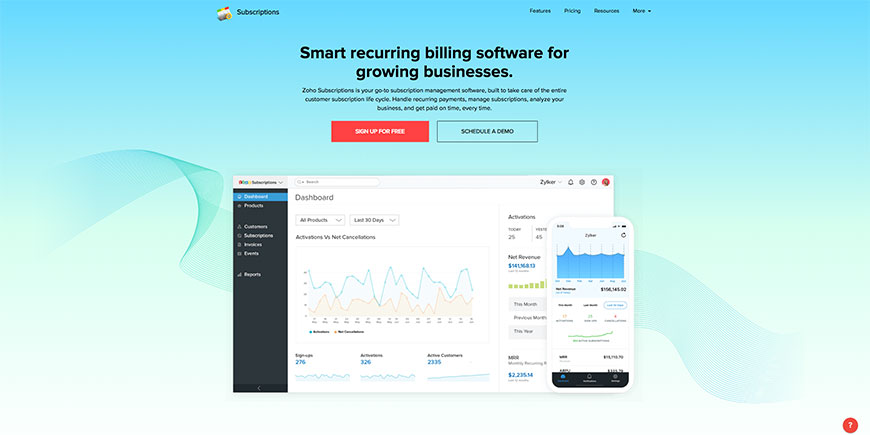
Zoho Subscriptions was renamed Zoho Billing in 2023 and absorbed into Zoho’s broader finance suite. Strong fit for organizations already using Zoho One — particularly those running Zoho CRM, Zoho Books, and Zoho Inventory — because the integration is tight and pricing is reasonable. Supports recurring billing, dunning, multi-currency, and tax across Zoho’s processor integrations.
What works: excellent value for Zoho One customers; the bundled pricing makes Zoho Billing one of the cheapest mature billing platforms when you factor in the rest of the Zoho stack. REST APIs and Webhooks support custom integrations. Free trial and self-serve onboarding, which not all enterprise billing platforms still offer.
Trade-offs: the platform is genuinely best when you’re committed to the Zoho ecosystem; using Zoho Billing alongside non-Zoho accounting (QuickBooks, Xero, NetSuite) requires extra integration work and sometimes loses analytics fidelity. Less developer mindshare than Stripe or Chargebee, so external resources and third-party expertise are scarcer.
How to Choose
For most SaaS teams in 2026, the choice flows from company stage and complexity:
- Pre-product-market-fit / earliest-stage SaaS: Stripe Billing or MoonClerk on top of Stripe. Fast to set up, low monthly fixed cost, easy to migrate later.
- Indie software / global digital products that don’t want to handle tax: FastSpring, Paddle, or Lemon Squeezy as merchant of record.
- Growth-stage B2B SaaS with complex pricing: Chargebee or Recurly on top of Stripe. Both handle proration, multi-currency, and dunning at the level enterprise customers expect.
- B2B SaaS that needs revenue recognition + billing in one place: Maxio (formerly Chargify) post-SaaSOptics merger.
- WordPress-based commerce or memberships: WooCommerce + WooCommerce Subscriptions + Stripe, or MemberMouse for membership-style businesses.
- Already using Zoho One: Zoho Billing keeps the stack consolidated.
- Working with a payments processor that wants the full stack: Stax Bill (formerly FuseBill) on Stax Payments, or Braintree’s built-in recurring features.
Most teams end up migrating once or twice as revenue scales — from a hosted-form tool (MoonClerk) to Stripe Billing, then sometimes to Chargebee or Recurly when complex billing or finance-team requirements outgrow Stripe’s primitives. Plan for that migration in your data model from day one (use stable internal customer and subscription IDs, not the processor’s IDs, as your system of record).
Frequently Asked Questions
What’s the difference between a payment processor and a subscription billing platform?
A payment processor (Stripe, Braintree, Adyen) actually moves money — it talks to the card networks, tokenizes card details, and handles authorization and settlement. A subscription billing platform (Chargebee, Recurly, Maxio) sits on top of one or more processors and adds plan logic, prorations, dunning, invoicing, tax, and revenue recognition. Some products (Stripe Billing, Braintree’s recurring module) blur the line by offering both.
Do I need both, or is one enough?
For most early-stage SaaS, Stripe Billing alone is enough — it’s a processor with a competent billing layer. As pricing complexity, multi-currency requirements, or finance-team needs grow, many teams add Chargebee or Recurly on top of Stripe to handle plan modeling and revenue recognition. The third option — merchant-of-record platforms like FastSpring, Paddle, and Lemon Squeezy — replaces both layers with a single vendor that also handles global tax compliance.
How do these tools help with PCI DSS compliance?
All of these platforms reduce your PCI scope by keeping cardholder data in their environment rather than yours. Hosted checkout pages (MoonClerk, FastSpring), redirect-style payment links (Stripe Checkout, Braintree Drop-in), and tokenized iframe-based fields all qualify for SAQ A — the lightest PCI self-assessment. PCI DSS 4.0 became mandatory in March 2024, with additional client-side script controls phased in through March 2025.
What about merchant-of-record platforms like Paddle or Lemon Squeezy?
Merchant-of-record (MoR) platforms — Paddle, Lemon Squeezy, and FastSpring among the picks above — handle global tax compliance themselves rather than passing it to you. They’re a strong fit for indie software shops and digital-product sellers who’d rather not staff an international tax function. The trade-off is higher per-transaction percentages (typically 5-9% versus a processor’s 2.9% + 30¢) and less direct relationship with the customer’s payment method on file.
Bottom Line
Recurring SaaS billing in 2026 has consolidated around a handful of clear winners: Stripe Billing as the default starting point, Chargebee and Recurly as the standalone billing platforms for complex needs, Maxio for B2B SaaS that wants billing plus revenue recognition in one tool, and FastSpring / Paddle / Lemon Squeezy as the merchant-of-record alternatives. Match the choice to your stage, pricing complexity, and tax-compliance appetite — and design your data model so the next migration is a straightforward swap rather than a six-month project. For more on related operational tooling, see our roundups of UX tools for designers and researchers and content planning tools for content marketing.