

What is SOC 2 compliance?
SOC 2 stands for Service Organization Control 2. It’s a reporting framework developed by the American Institute of Certified Public Accountants (AICPA) that audits how a service organization manages customer data against the Trust Services Criteria (TSC). The current TSC is the AICPA’s 2017 framework (with subsequent points-of-focus updates), built around five categories:
- Security — required for every SOC 2 report.
- Availability — the system is available for operation and use as committed.
- Processing Integrity — system processing is complete, valid, accurate, timely, and authorized.
- Confidentiality — information designated as confidential is protected.
- Privacy — personal information is collected, used, retained, disclosed, and disposed of in conformity with commitments.
Service organizations choose which categories the audit will cover beyond Security, scoped to what they actually commit to customers. A licensed CPA firm performs the audit and issues the report; the report is then shared with prospects, customers, and partners under NDA as evidence of the organization’s control posture.
SOC 2 isn’t legally mandated, but it has become a practical requirement for B2B SaaS companies selling to enterprise, financial-services, healthcare-adjacent, or public-sector buyers. Many procurement and security questionnaires (CAIQ, SIG) now include “Do you have a current SOC 2 Type 2 report?” as a yes/no qualifier, and “no” routinely ends the deal.
Why SOC 2 compliance matters
Three concrete benefits show up consistently for organizations that complete a SOC 2:
- Sales velocity. A current SOC 2 Type 2 report short-circuits hundreds of vendor-security questions. Most enterprise buyers will accept the report in lieu of a custom security review.
- Lower breach risk. The audit forces real implementation of the controls — access reviews, MFA, change management, vendor risk, incident response — that turn out to matter when something goes wrong.
- Cross-framework leverage. Most modern compliance platforms map SOC 2 controls to ISO 27001, HIPAA, PCI DSS, GDPR, NIST CSF, and increasingly NIST AI RMF / ISO 42001 for AI-using companies. One control inventory, multiple reports.
SOC 2 Type 1 versus Type 2: what’s the difference?
Type 1 assesses whether your controls are designed appropriately at a single point in time. It’s a snapshot — useful as a stepping stone or for very young companies, and faster and cheaper to obtain.
Type 2 assesses whether the controls are designed and operating effectively over a defined observation period. The minimum is generally 3 months for a first-time Type 2; most mature organizations run 6 or 12-month observation windows. Type 2 is what enterprise buyers actually want — Type 1 is rarely sufficient on its own once you’re past pre-revenue.
Who can perform a SOC 2 audit?
Only a licensed CPA firm can issue a SOC 2 report — that’s the AICPA-imposed requirement. Within that, three categories of firms commonly handle SOC 2 work:
- CPA / audit firms — traditional accounting firms with an IT-audit practice. Schellman, A-LIGN, KirkpatrickPrice, RSM, BDO, Coalfire (through its CPA partner), and the Big Four all fit here.
- IT-audit specialist firms — boutique cybersecurity-and-compliance shops (Coalfire, KirkpatrickPrice, Schellman) where SOC 2 is core practice rather than an offshoot of financial audit.
- Compliance automation platforms with audit partnerships — Vanta, Drata, Secureframe, Sprinto, and Thoropass don’t issue the report themselves but pair their evidence-collection software with a partner CPA firm (Thoropass uniquely offers in-house auditors via its 2023 model).
Match the auditor to your industry. A SOC 2 auditor with healthcare-SaaS experience will price and scope very differently from one focused on fintech or pure-play B2B SaaS, and customers in regulated industries often prefer auditor brands they recognize.
Top 10 SOC 2 compliance firms and platforms
The market splits into two groups: compliance-automation platforms that prepare you for the audit (typically positioned as “get SOC 2 in weeks, not months”) and CPA firms that actually issue the report. Modern programs use one of each. Below: five leading platforms followed by five leading audit firms.
1. Sprinto
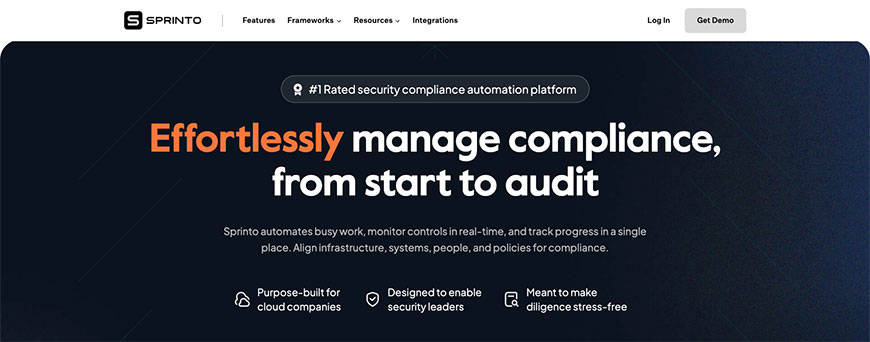
Sprinto is a cloud-based compliance automation platform that consolidates evidence collection, control monitoring, and audit-readiness in one place. Built around continuous monitoring of entity-level controls, the platform supports SOC 2, ISO 27001, HIPAA, and GDPR. Sprinto pairs with partner CPA firms for the audit itself; the platform’s strength is the speed at which startups can stand up a full control program.
2. Vanta
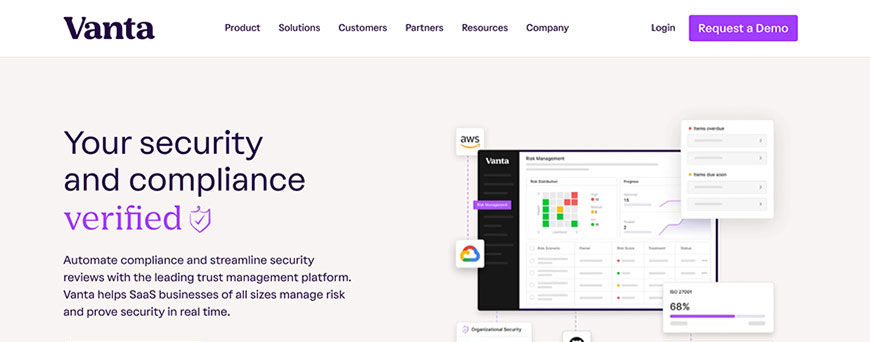
Vanta is the most widely adopted SOC 2 automation platform among Series A/B SaaS companies. It connects to your cloud accounts (AWS, GCP, Azure), HRIS, identity provider, and ticketing tools to continuously collect evidence, runs gap assessments, manages policies, and ports the same control set into ISO 27001, HIPAA, GDPR, and PCI reports. Vanta partners with multiple CPA firms for the audit; its market footprint and integration breadth make it the default many founders consider first.
3. Secureframe
Secureframe is a compliance and security platform that combines automated evidence collection, policy management, vendor risk, and risk assessments. It supports SOC 2, ISO 27001, HIPAA, PCI DSS, NIST, and CMMC, with strong reporting for security and trust pages. Especially popular with companies that want a unified view across multiple compliance frameworks rather than a single SOC 2 push.
4. Drata
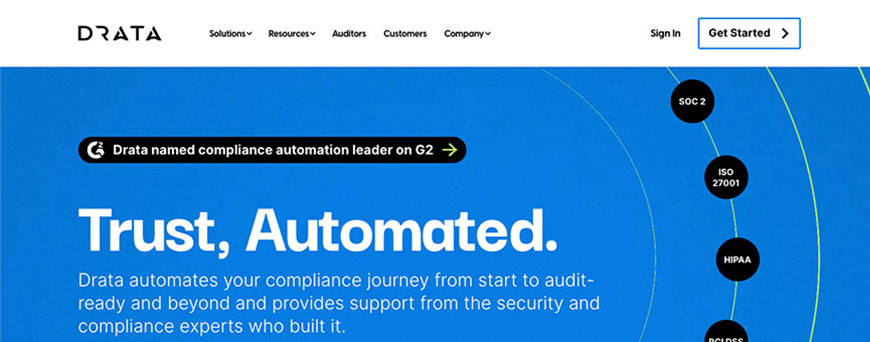
Drata provides automated control monitoring, risk assessment, and remediation guidance for SOC 2, ISO 27001, HIPAA, PCI, and GDPR. Strong on continuous-monitoring depth and the breadth of its integrations library. Frequently the choice for companies with complex environments where automated evidence collection materially shrinks the audit timeline.
5. Thoropass
Thoropass (formerly Laika, rebranded in 2023) bundles compliance software and in-house auditors. The combined model collapses the typical platform-plus-CPA-firm split into a single contract and timeline, which can substantially reduce time-to-report for first-time SOC 2 organizations. Covers SOC 2, ISO 27001, HIPAA, GDPR, PCI, and CCPA.
6. A-LIGN
A-LIGN is a licensed CPA firm and one of the highest-volume SOC 2 issuers in the U.S. Their A-SCEND platform integrates with most compliance-automation tools (Vanta, Drata, Secureframe), so companies can use A-LIGN as the auditor while still running their preferred evidence-collection software. Strong fit for organizations who want a recognized auditor brand.
7. KirkpatrickPrice
KirkpatrickPrice is a licensed CPA firm specializing in information security audits and assessments. Their SOC 2 practice takes a risk-based approach and serves businesses across industries; they also provide SOC 1, PCI DSS, HIPAA, HITRUST, ISO 27001, and GDPR assessments. Known for client education during the audit process — a real plus for first-time organizations.
8. Coalfire
Coalfire is a leading cybersecurity advisory and assessor, with FedRAMP, StateRAMP, PCI QSA, HITRUST, and SOC services across a single firm. Their SOC 2 practice (delivered through Coalfire’s licensed CPA arm) is well-suited for companies with multiple parallel compliance obligations or federal-government customers.
9. Schellman
Schellman is a top-tier IT audit and assessor firm and one of the largest SOC 2 issuers globally. Highly regarded among enterprise buyers and frequently the auditor of record for late-stage SaaS and public companies. Also active in FedRAMP, ISO 27001, HITRUST, PCI DSS, and ISO 42001 (AI management) audits as that market matures.
10. RSM
RSM is a global firm providing audit, tax, and consulting services with an established SOC 2 practice. Their team works with both mid-market and enterprise organizations, and they offer the broader risk-management and cybersecurity advisory services that mid-market organizations often want bundled with the audit.
Frequently asked questions
How long does a first SOC 2 audit take?
Most first-time SOC 2 Type 1s take 2-4 months from kickoff to report once a compliance platform is in place. A first-time Type 2 typically takes 4-8 months total — preparation plus the observation window plus fieldwork plus reporting. Subsequent annual Type 2s are faster because the controls are already running.
How much does SOC 2 cost?
Budget ranges in 2026: $15K-$30K for a Type 1 audit; $25K-$60K+ for a Type 2 audit, depending on scope, system complexity, and auditor brand. Add $10K-$50K/year for a compliance-automation platform. Big Four and top-tier specialist auditors (Schellman, A-LIGN, KirkpatrickPrice) sit at the higher end; mid-market specialists at the lower end.
Do I need both a platform and an auditor?
For most companies, yes — a compliance platform (Vanta, Drata, Secureframe, Sprinto) handles continuous evidence collection and the auditor (A-LIGN, Schellman, KirkpatrickPrice, RSM, etc.) issues the report. The exception is Thoropass, which bundles both into one engagement.
Does SOC 2 cover AI risk?
SOC 2 itself is framework-agnostic, so AI-using companies typically extend it with additional criteria. Two paths: layer NIST AI RMF or ISO 42001 (the AI management-system standard) on top of SOC 2 controls, or extend the SOC 2 scope itself with custom criteria. Most major compliance platforms now offer ISO 42001 readiness modules as an add-on.
What replaces SOC 2 internationally?
For European customers, ISO/IEC 27001 is the equivalent expectation; for healthcare, HIPAA assessments and HITRUST certification often complement or replace SOC 2; for PCI-touching environments, PCI DSS v4.0 assessment is the relevant report. Most modern compliance platforms map a single control set across all of these.
The bottom line
Choosing the right SOC 2 path is mostly about matching the platform-plus-auditor combination to your stage, scope, and customer expectations. Early-stage SaaS founders typically pair Vanta or Drata with a mid-market CPA firm. Late-stage and enterprise SaaS often choose Schellman or A-LIGN as the auditor regardless of which platform is underneath. Whatever combination you choose, get to a current SOC 2 Type 2 — it’s the single most-cited control artifact in modern enterprise procurement, and the cost of not having one keeps growing.