
What Makes an SEO Blog Worth Following in 2026?
The SEO publishing landscape has gotten noisier, not less. Thousands of blogs claim to cover search. Most republish the same few takes on each Google update, and many lean hard on AI-generated summaries that add no original insight. Picking blogs worth your time comes down to four filters.
Original research or reporting. The best SEO blogs run their own experiments, pull from their own tool data, or break news before anyone else does. Anything that just recycles a Google announcement is second-hand at best.
Current on AI search. AI Overviews, ChatGPT Search, Perplexity, and Google’s generative answers have rewired organic traffic faster than any algorithm change in the past decade. Blogs that are still writing like it’s 2022 aren’t useful. Look for publishers who are measuring AI Overview impact, tracking LLM citation patterns, and publishing framework updates for the new reality.
Specific to your work. Technical SEO, local SEO, e-commerce SEO, international SEO, and content SEO are all different jobs. A blog heavy on link-building case studies won’t help someone doing enterprise technical audits. Pick sources matched to the tasks actually on your plate.
Low noise-to-signal. Daily publication isn’t always a plus. Some of the highest-signal SEO content in 2026 ships once a week in a newsletter. The question isn’t how many posts a blog publishes, it’s how many of them you’d actually save to come back to.
The 25 Best SEO Blogs to Follow in 2026
The list below is ordered roughly by influence, publication cadence, and how useful the content has been over the past year — not by any strict rank. Every blog has been verified active in 2026.
1. Google Search Central Blog
Start here. Google’s own Search Relations team publishes every major algorithm change, every documentation update, and every new feature through this blog. If you only follow one source, make it this one. The news is often weeks ahead of the third-party coverage that summarizes it.
The team (John Mueller, Gary Illyes, Lizzi Sassman, Martin Splitt, and others) also produces Search Off the Record, a podcast where Google engineers talk through the how and why of search decisions. Both are free, ad-free, and don’t promote any product. Posts are short and technical, which means they respect your time.
Recent coverage has included definitive guidance on AI Overviews eligibility, structured-data requirements for generative search, and the shift toward quality signals in the 2026 core updates. Pair the blog with one news publication that adds commentary, and you’ve got a solid core feed.
Best for: anyone who needs to stay current with official Google guidance, especially technical SEOs and anyone responsible for large sites.
2. The Moz Blog
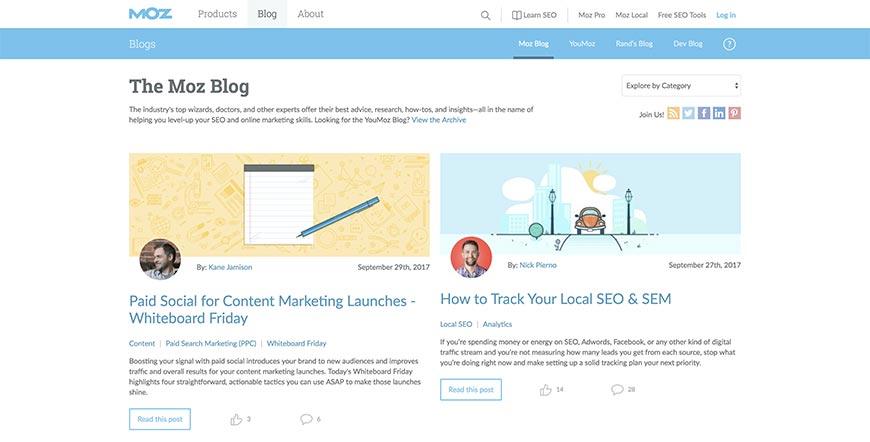
Moz has been a cornerstone of the SEO community since 2004, famous for its Whiteboard Friday video series and approachable tutorials. The blog still publishes several posts a week across keyword research, link building, and Google algorithm analysis. Its beginner guides continue to show up at the top of search results for the phrases they target, which is its own quiet testimonial.
The Moz Beginner’s Guide to SEO is the most-cited free SEO resource on the web, and the team updates it substantially every year. Moz also publishes one of the longest-running SEO research projects with its biennial Search Ranking Factors studies. The tone is teacherly and generous with knowledge, which makes it one of the few major SEO publications that doesn’t feel like a sales funnel.
Best for: practitioners who want technical depth without jargon, and anyone getting started in SEO.
3. The Ahrefs Blog
Ahrefs publishes some of the most rigorous data-driven SEO content anywhere on the web. The blog pulls from their 35-trillion-link index and 494-million-domain database to back up claims that would be speculative anywhere else. Case studies, link-building experiments, and step-by-step how-tos make up the bulk of what they publish.
The team has published original research on topics like what percentage of top-ranking pages actually earn backlinks (the answer: fewer than you’d think), how often Google re-crawls deep pages, and the typical timeline from publishing to ranking. These are the kinds of pieces other SEO blogs cite for years.
The Ahrefs YouTube channel is a strong supplement, particularly Sam Oh’s tutorials. Between the blog, YouTube channel, and free tools (Webmaster Tools, Keyword Generator), Ahrefs offers one of the most generous free resource sets in the industry.
Best for: intermediate-to-advanced SEOs who want data, not opinions.
4. Semrush Blog
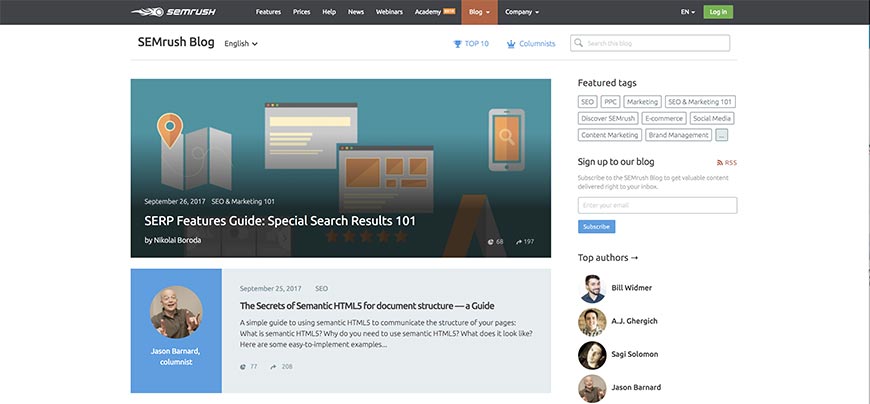
Semrush covers SEO, content marketing, paid search, and social from every angle. The blog benefits from the company’s broad data access: 43 trillion backlinks, 390 million domains, and a 15-minute link-index refresh cycle. Claims are usually backed by hard numbers.
Semrush acquired Backlinko in 2022, and Brian Dean’s long-form content now lives alongside Semrush’s own publishing. The combined library is enormous and kept current. Semrush also publishes regular State of Search reports and runs one of the largest SEO podcasts, with interviews that often include senior Googlers and platform engineers.
The blog is more marketer-oriented than Ahrefs, with more content on strategy and less on raw SEO mechanics. Both are worth reading, and the redundancy is less than you’d think.
Best for: SEO managers and content strategists who want coverage across all of organic and paid.
5. Yoast SEO Blog
Yoast makes the most widely installed WordPress SEO plugin, and the blog reflects that: a mix of WordPress-specific technical guides, structured-data tutorials, and readable on-page SEO primers. Good for anyone managing a WordPress site. The content still pops up for long-tail queries about Yoast plugin features.
Beyond the plugin-centric content, Yoast publishes substantial content on structured data, readability, and international SEO. The company has also invested in accessibility research, publishing regular posts on how SEO and a11y overlap. For WooCommerce stores, the content on product-schema and breadcrumbs is especially useful.
Best for: WordPress site owners, content editors, and anyone using the Yoast plugin.
6. Sistrix Blog
Sistrix’s blog is one of the best sources of cold-eyed analysis on Google algorithm updates and AI Overviews in 2026. The team publishes detailed visibility analyses after every core update. Their coverage of the March 2026 core update and their measurement of AI Overview click-through rates (position-one CTR falling from 27% to 11% when an AI Overview shows) is the kind of data most blogs simply don’t have.
Sistrix is particularly strong on European search data, which fills a gap most US-focused blogs leave open. German, French, and Spanish search market coverage is routine, and comparisons between markets often surface patterns that wouldn’t show up in a US-only view. The blog is not hype-driven. If a Google update doesn’t actually move the needle, Sistrix says so.
Best for: SEOs who want primary-source data on algorithm changes, and anyone working on multi-market or European-focused sites.
7. Conductor Blog (formerly Searchmetrics)
Conductor acquired Searchmetrics in February 2023, merging two of the largest enterprise SEO platforms into one. The combined blog focuses on enterprise and international SEO, AI search optimization, and large-scale technical audits. Useful for anyone working on sites with tens of thousands of pages or multi-market deployments.
Conductor’s research arm publishes longer original studies than most blogs can manage: ranking factor analyses, industry vertical deep dives, and AI Overview citation research. The enterprise positioning shows in the depth. If you’re working in-house at a Fortune 500 or at an agency serving enterprise clients, the blog speaks your language.
Best for: in-house enterprise SEOs and agency teams working on large, complex sites.
8. BrightEdge SEO Blog
BrightEdge is the other large enterprise SEO platform, and its blog leans into original research on AI search, share of voice, and organic performance. Recent coverage has highlighted the growing role of AI agents in online shopping (their 2026 prediction is that most online customers will be AI agents by year-end) and how enterprise teams are restructuring around AI-driven discovery.
The blog’s Data Cube feature posts surface specific query-level data that illustrate emerging SERP patterns. If Conductor’s blog is denser and more academic, BrightEdge’s is more punchy and prediction-oriented.
Best for: enterprise SEO leaders and digital marketing VPs who want strategic framing of where search is headed.
9. CognitiveSEO Blog

CognitiveSEO focuses on backlink analysis and content optimization. The blog publishes practical tactics with data behind them: how to recover from a penalty, how to audit a backlink profile, how to structure content for topical authority. Quieter cadence than the big tool blogs, but strong signal when they do publish.
The team has been particularly strong on unnatural-link detection and has published multiple case studies on recovery from manual actions. For anyone whose SEO work involves competitor backlink research, cleanup of acquired sites, or defensive link monitoring, CognitiveSEO is a reliable stop.
Best for: link-focused SEOs and anyone doing backlink audits.
10. Search Engine Journal
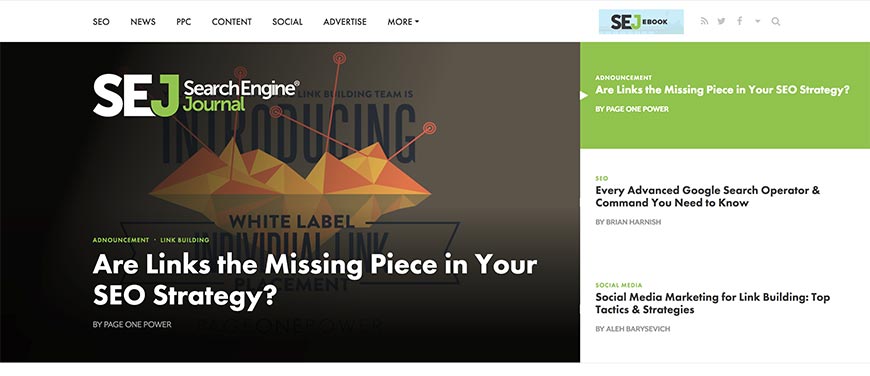
One of the most active SEO publications on the web, SEJ publishes multiple posts a day across SEO, PPC, social, content, and AI. Coverage is timely: breaking Google news usually appears within hours. The site’s long-form guides are regularly updated, which makes it one of the few legacy SEO publications that doesn’t feel like a 2015 time capsule.
SEJ’s contributor roster is deep: Kevin Indig, Lily Ray, Roger Montti, and a rotating cast of industry specialists all publish there. The podcast network includes shows on technical SEO, PPC, and content strategy, and the annual State of SEO report pulls data from thousands of practitioners.
The volume is high enough that you’ll want to subscribe to their topic feeds (SEO, AI Search, Local SEO) rather than trying to read everything.
Best for: daily industry news and broad SEO coverage.
11. Search Engine Land
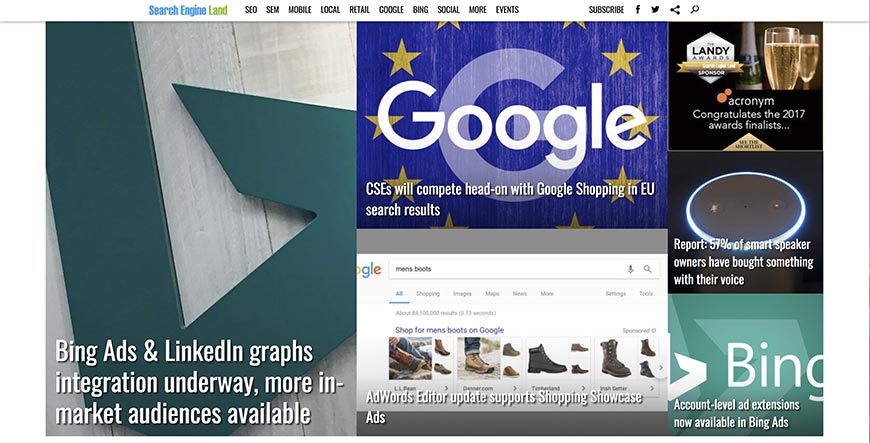
Founded by Danny Sullivan (now at Google) in 2006, Search Engine Land has been the industry’s paper of record for nearly two decades. Strong opinion columns, deep algorithm-update analysis, and a long bench of contributors including Aleyda Solis, Barry Schwartz, and Lily Ray. Particularly strong for news coverage of Google, Bing, and AI search.
Search Engine Land’s editorial standard is stricter than most SEO publications, which shows in the analysis. When they cover a core update, expect data from multiple rank-tracking vendors and commentary from a handful of named experts, not just a rehash of the Google announcement. The site also runs SMX conferences, which means many posts are written by speakers sharing depth from their sessions.
Best for: comprehensive industry news with more editorial depth than most SEO publications.
12. Search Engine Roundtable
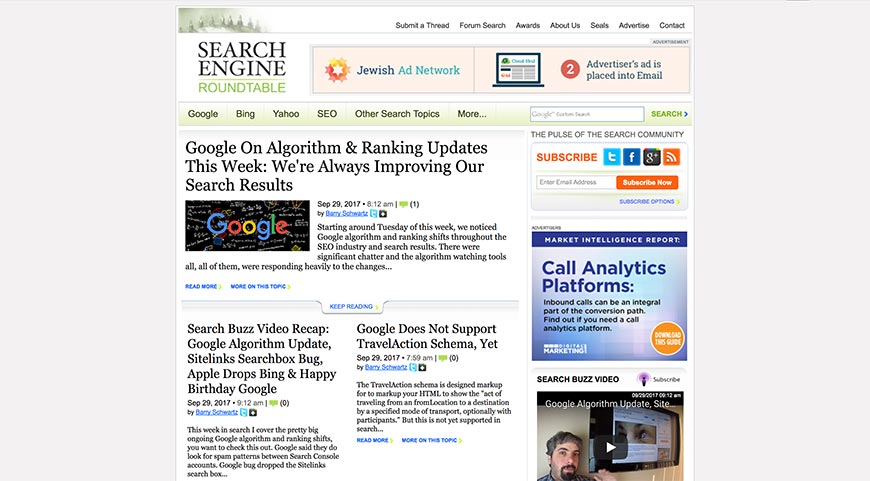
Barry Schwartz has been running Search Engine Roundtable since 2003 and posts several times a day, every day. It’s the best place on the web for real-time Google algorithm chatter, Search Console quirks, and forum-discovered ranking shifts. If you need to know whether a Google update is rolling out right now, check here first.
The posts are short and transactional: Barry surfaces chatter from webmaster forums, notes ranking fluctuations picked up by rank trackers, and confirms or denies rumors with whatever data is available. When Google makes a subtle change (a new SERP feature, a tweaked algorithm behavior), Roundtable will usually have caught it before anyone else.
Best for: anyone who needs to know about Google changes in near-real-time.
13. Search Engine Watch
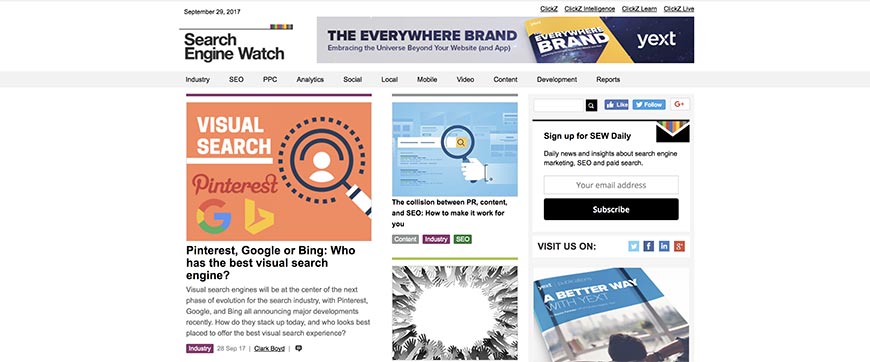
One of the oldest SEO publications on the web, Search Engine Watch still publishes new content regularly and covers meta tags, GenAI platform visibility tracking, and comparisons between traditional and AI-based search. Overlaps with Search Engine Journal on news coverage. Useful as a second read for different perspectives.
Search Engine Watch leans more toward case studies and how-to guides than breaking news. The content is less time-sensitive than SEJ or Search Engine Land but often more practical, with step-by-step tutorials that you can apply the same day.
Best for: practitioners who want how-to guides alongside industry news.
14. Neil Patel’s Blog
Neil Patel is polarizing. Some SEOs love his approachable, beginner-friendly writing, and others find it too broad. What’s not debatable is the consistency: the blog publishes several long-form guides a week across SEO, content marketing, and AI. Best for foundational topics. Less useful if you’re already advanced.
The blog’s real strength is its breadth of coverage on adjacent topics: email marketing, social, conversion optimization, and paid media all appear regularly. For generalist marketers who touch SEO alongside other channels, that coverage makes the site a useful single-source read. The Ubersuggest tool also feeds case studies and original data back into the blog.
Best for: generalist marketers and SEO beginners.
15. Backlinko
Brian Dean built Backlinko into a household name on the back of long, exhaustively researched guides on link building, on-page SEO, and keyword research. Semrush acquired Backlinko in 2022, and while Brian has largely moved on to a newsletter (Exploding Topics), the Backlinko guides remain canonical and are kept up to date.
The Skyscraper Technique, first documented on Backlinko, has been cited by virtually every SEO blog in existence, and the template-style long-form guides Brian pioneered are now industry-standard format. The archive alone is worth an afternoon of reading.
Best for: anyone who wants to learn link building, on-page SEO, and keyword research from canonical sources.
16. SEOFOMO by Aleyda Solis
If you only subscribe to one SEO newsletter in 2026, make it this one. Aleyda Solis, an international SEO consultant and one of the most respected technical SEOs in the industry, publishes a weekly roundup of the most important SEO news, resources, jobs, and events to 35,000-plus subscribers. Supplemented by her Crawling Mondays video series and the LearningSEO.io free roadmap.
What sets SEOFOMO apart is the curation. Aleyda reads everything and picks only what’s worth your time. Each newsletter also highlights underrated voices, upcoming conferences, and actively hiring SEO roles, which makes it useful for career development in addition to technical learning. The Ahrefs team has called SEOFOMO one of the best SEO newsletters in existence, and that consensus is pretty broad.
Best for: anyone who wants a high-signal weekly digest instead of daily feeds.
17. Growth Memo by Kevin Indig
Kevin Indig’s Growth Memo is the newsletter to read for data-backed SEO strategy in the AI era. He covers agentic SEO, LLM visibility, and the shift from ranked lists to definitive answers, with analysis you won’t find in the big industry publications. Over 25,000 subscribers.
Kevin previously led SEO at Shopify and G2, which shows in his framing. His analysis tends to be strategic rather than tactical: how to think about SEO as a growth function, when to invest in content vs. technical work, and what actually moves the needle for business outcomes. The newsletter’s AI-search coverage (the State of AI Search Optimization reports in particular) is some of the best in the industry.
Best for: senior SEOs, growth leaders, and anyone making strategic SEO decisions.
18. The Bruce Clay Blog
Bruce Clay has been in SEO since the 1990s — literally the first full decade of the field. The blog reflects that depth with rigorous, technical coverage of on-page optimization, site architecture, and the ways Google’s evaluation has evolved over time. Less frequent than the daily publications but consistently substantial.
Bruce Clay’s own SEO Code of Ethics predates most of today’s SEO conferences and still holds up. The agency publishes detailed technical guides on siloing, internal linking, and information architecture that are referenced widely. The voice is senior-practitioner, which some readers find dense and others find refreshingly direct.
Best for: veteran SEOs and anyone looking for the long-view perspective on the field.
19. Reliablesoft by Alex Chris
Alex Chris runs one of the most comprehensive solo SEO blogs in the space. The site covers SEO fundamentals, digital marketing courses, and WordPress tutorials. Content is detailed enough to be practically useful and simple enough that newer marketers can follow along.
Reliablesoft’s courses have taught thousands of practitioners and the blog’s beginner guides get referenced in onboarding docs across agencies and in-house teams. The writing is plain and patient, which is exactly what new SEOs need.
Best for: SEO fundamentals and anyone training up junior marketers.
20. Gotch SEO
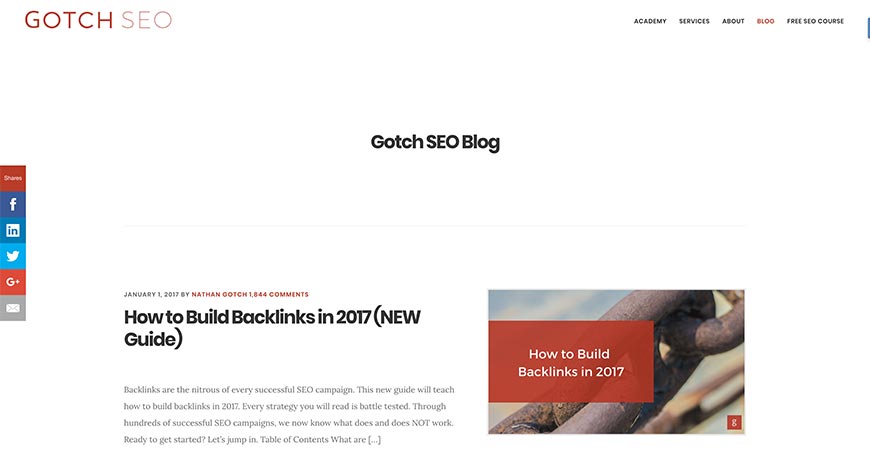
Nathan Gotch’s blog is specialized: it focuses almost exclusively on link building and content strategy for ranking competitively. Posts are long, specific, and drawn from actual agency client work. If link building is a big part of your SEO plan, this is one of the best sources for tactics that still work in 2026.
Nathan also runs Gotch SEO Academy, a training program with an active community, and much of what gets tested there eventually shows up on the blog. The content leans toward affiliate and lead-gen sites, which is where the margin-for-error on SEO is smallest, so the tactics tend to be tested hard before they’re published.
Best for: link builders, affiliate marketers, and lead-gen site operators.
21. ClickZ Media
ClickZ rebranded to ClickZ Media in May 2025 under Contentive and now covers SEO alongside broader B2B marketing topics: programmatic, performance media, and commerce. Less SEO-focused than it once was, but the broader lens is useful for digital marketers working across channels.
The site has several themed newsletters (DTC Ecommerce, Retail Media, Agency Edition) that often contain the most current takes on how SEO is shifting alongside the rest of the B2B marketing stack. For anyone whose role spans SEO plus paid, programmatic, or commerce, ClickZ’s cross-channel framing is valuable.
Best for: digital marketing generalists and marketers who work across SEO and paid channels.
22. Crazy Egg Blog
Crazy Egg (formerly The Daily Egg) covers the overlap of SEO, conversion rate optimization, and UX. The blog is less about ranking for queries and more about what happens once visitors land on a page. Useful for anyone whose SEO work is measured on conversions, not just traffic.
Posts regularly dig into heatmap data, session recordings, and A/B testing outcomes, which makes the blog one of the few places where SEO and CRO actually converge rather than sitting in separate silos. Teams that measure organic success by revenue rather than sessions will get more from Crazy Egg than from most pure-SEO blogs.
Best for: SEOs who own conversion goals and site owners focused on revenue per session.
23. Reddit r/SEO
Not a blog exactly, but one of the fastest pulse-checks on what’s working and breaking in search right now. The community discusses algorithm changes in real time and is less filtered than the official channels. Noisy, but sometimes catches signal that the major publications miss.
Reddit’s SEO community also tends to surface things established publications don’t cover: gray-hat experiments, niche-site case studies, candid conversations about what clients are actually paying for, and frustrations with specific Google behaviors. Treat it as a supplement, not a primary source, and you’ll get good value.
Best for: real-time sentiment, gray-hat experiments, and community Q&A.
24. HubSpot SEO Blog
HubSpot’s marketing blog has one of the largest audiences in the industry, and the SEO section publishes thorough how-to guides that tend to rank well themselves. Strong for inbound-marketing-oriented SEO, content strategy, and the intersection of SEO with the rest of the marketing stack.
HubSpot’s content tends to emphasize foundational topics and use case studies drawn from their own vast customer base. Content is heavily edited and SEO-optimized, which sometimes makes it feel formulaic, but the depth and reliability of information is consistent. The team publishes State of Marketing reports each year that include specific data on how SEO budgets are shifting.
Best for: content marketers and inbound-focused SEOs.
25. SE Ranking Blog
SE Ranking is a mid-market SEO platform, and its blog publishes guides on keyword research, rank tracking, technical audits, and local SEO. Less influential than Moz or Ahrefs, but often more accessible, and the team publishes original research on things like AI-search traffic shifts.
The blog also publishes in multiple languages, which makes it a useful stop for non-English market coverage. Content tends to be well-illustrated with tool screenshots, which is helpful for beginners learning the mechanics of audits, rank tracking, or keyword clustering. SE Ranking’s AI Overview impact reports have been some of the most specific in the industry on vertical-by-vertical traffic changes.
Best for: SMB SEOs, agency teams at smaller agencies, and practitioners in non-English markets.
Frequently Asked Questions
How many SEO blogs should I follow?
Four or five focused on your actual work is plenty. Trying to read 25 blogs a week is how people burn out or stop reading entirely. Pick one authoritative source (Google Search Central), one news publication (Search Engine Journal or Search Engine Land), one tool blog for data (Ahrefs or Sistrix), one solo voice (SEOFOMO or Growth Memo), and one topical blog matched to your focus (Gotch SEO for links, Yoast for WordPress, Crazy Egg for CRO).
Are SEO blogs still relevant with AI answering questions directly?
More than ever. AI Overviews and generative search have made search results more volatile, and the best SEO blogs are now where you learn how to respond. Sistrix, Kevin Indig, and Aleyda Solis in particular have been ahead of the curve on AI search optimization. If anything, the pace of change has made current, expert commentary more valuable than any static reference or cached document.
What’s the difference between an SEO blog and an SEO newsletter?
A lot of the most valuable SEO commentary in 2026 lives in newsletters (SEOFOMO and Growth Memo are two examples), because the format lets solo experts publish without the ad-driven incentives of a traditional blog. Some newsletters are free, some have paid tiers for deeper analysis. Most arrive in your inbox weekly, which is a lower-friction way to stay current than daily site visits. The trade-off is that newsletter archives are often harder to search than blog archives.
Which SEO blog is best for beginners?
Moz, Yoast, and Backlinko are the most beginner-friendly of the major blogs. All three write for people who are still learning the vocabulary, and all three keep their foundational guides updated. Neil Patel’s blog and Reliablesoft are also good starting points, especially for solo marketers who wear more than one hat. If you’re brand new, start with Moz’s Beginner’s Guide to SEO and work outward.
Are there any great SEO podcasts to pair with these blogs?
Yes. Google’s Search Off the Record is the insider view. The Search Engine Journal Show covers industry news and tactics. Marketing O’Clock (from Search Engine Journal) is a weekly news round-up. The Authority Hacker Podcast covers SEO for affiliate and niche sites. Search With Candour is a British take with strong technical depth. One 30-minute podcast episode during a commute can replace an hour of blog reading most weeks.
How do I know if an SEO blog is still worth following?
Check the publish date on the most recent post. If the last post is more than three months old and the blog isn’t a consultant’s personal site (where low cadence is expected), it’s probably dormant. Also check whether the recent posts are addressing 2026 realities: AI Overviews, INP as a ranking signal, modern JavaScript rendering, and the shift to entity-based search. Any SEO blog that is still writing like it’s 2022 is missing the most important changes of the past two years.
Bottom Line
The SEO publications worth following in 2026 are a mix of legacy institutions that still put in the work, new voices who cut through the noise, and tool blogs with actual data behind their claims. Google’s own Search Central Blog should anchor the list for everyone — no one else breaks algorithm news first.
Beyond that, build a short rotation that fits your actual work. Read daily if you can. The only thing that separates SEOs who keep pace from those who fall behind is how much of the industry’s output they actually see. Set up an RSS reader or a dedicated email inbox for SEO newsletters so the feeds don’t get lost in the rest of your day.
For a broader sweep of the field, our guide to the best CMS for SEO in 2026 and our deep dive on JavaScript and SEO pair well with almost everything above.