
Strong project planning means working with a clear-eyed view of what helps and hinders the work — internal capabilities, external conditions, where the team has an edge, and where it’s exposed. The SWOT analysis (Strengths, Weaknesses, Opportunities, Threats) is one of the longest-running frameworks for surfacing those factors, used across corporate strategy, marketing, social work, government, and personal planning. This guide covers what SWOT is, when it’s most useful, where it falls short, modern variants and complementary frameworks (TOWS, SOAR, VRIO, PESTLE, Porter’s Five Forces), and the collaborative tools teams use to run SWOT sessions in 2026.
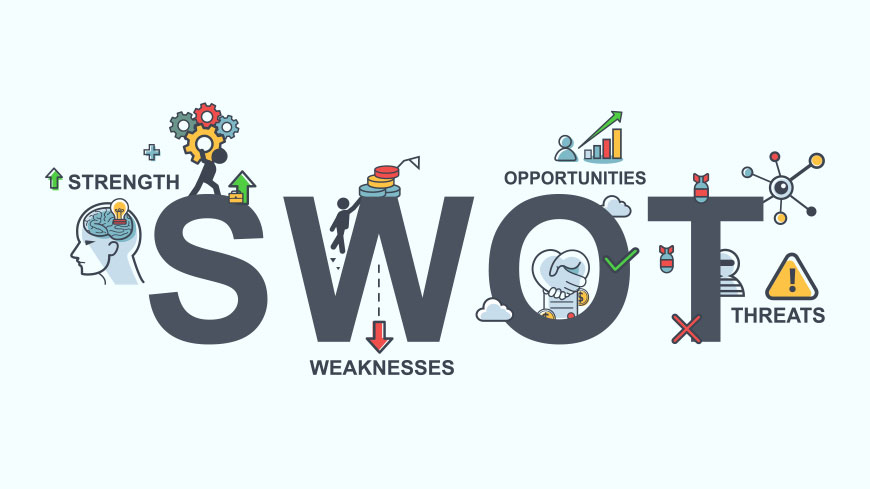
SWOT analysis is a structured way to surface the internal and external factors affecting a project, decision, or strategy. It pairs particularly well with the upstream stages of project planning — discovery, scoping, strategy, and stakeholder alignment — and remains one of the most widely taught planning frameworks in business schools and project management courses worldwide.
This article gives an overview of SWOT and where it fits, including the modern variants and collaborative tools that have become standard in 2026. SWOT is a framework, not a complete planning method — pair it with the right complementary tools and the right team-collaboration platform, and it produces real insight.
What is SWOT?
SWOT is an acronym for Strengths, Weaknesses, Opportunities, and Threats. The framework was developed at the Stanford Research Institute (SRI) in the 1960s — most often credited to Albert Humphrey’s SOFT (Satisfactory, Opportunity, Fault, Threat) analysis, which evolved into the SWOT terminology used widely from the 1980s onward.
The framework structures a project assessment around four quadrants:
- Strengths — internal qualities that give the project, product, team, or organization an advantage.
- Weaknesses — internal qualities that put it at a disadvantage.
- Opportunities — external conditions that play to the project’s strengths or could be exploited.
- Threats — external conditions that could exploit weaknesses or undermine the project.
The output is typically rendered as a 2×2 matrix with the four quadrants visible at a glance. The matrix itself isn’t the deliverable — the deliverable is a sharper understanding of where to place bets, where to defend, and what conditions favor or threaten the work.
Internal versus external factors
The fundamental distinction in SWOT is internal versus external:
- Internal factors are inside the organization, team, or project: existing infrastructure, people and expertise, financial assets, brand reputation, intellectual property, processes, relationships. Strengths and Weaknesses both live here.
- External factors sit outside the organization: market trends, competitor moves, regulatory changes, technological shifts, customer needs, economic conditions, geopolitical events. Opportunities and Threats both live here.
The same factor can be a Strength in one situation and a Weakness in another, or a Threat that becomes an Opportunity once the framing changes. The point of structured analysis is to surface the factors and let the team debate the framing — not to pre-categorize them rigidly.
When to use SWOT
SWOT works best at decision points where the team needs to align on the landscape before committing to a path. Common applications:
- Project kickoff — establish the starting context before the team commits to scope and approach.
- Strategy reviews — annually or quarterly, to test whether the existing strategy still fits the changed environment.
- New-market entry — assess whether the team’s strengths translate to a new geography, segment, or product category.
- Competitive analysis — run SWOT on key competitors to find gaps to exploit and threats to defend against.
- Crisis response — quickly characterize the situation when something major changes (regulatory shift, competitor exit, major incident, technology disruption).
- Stalled projects — surface what’s actually blocking progress when momentum has stalled.
- Personal or career planning — applied to individual decisions about career moves, education, or skill investment.
SWOT applications across organizations
SWOT isn’t restricted to corporate use — it adapts well to non-profits, government departments, community groups, and individual projects. The category that SWOT consistently underperforms in is rapid quantitative analysis: it’s qualitative by design, so it’s a starting point for analysis rather than a substitute for data.
Strategy
Corporate, product, and program strategy all benefit from SWOT during the framing phase. The 2×2 matrix makes internal and external factors visually clear so leadership and stakeholders can align on the landscape. When Strengths and Opportunities are strongly aligned, the strategy can be more aggressive (Strength-Opportunity / SO strategy in the TOWS framework). When Weaknesses and Threats dominate, the strategy needs to be more defensive (Weakness-Threat / WT). Mixed cases produce Strength-Threat (SO defensive strategy) or Weakness-Opportunity (WO improvement strategy) framings.
Match and convert
Two common workflows that integrate naturally with SWOT:
- Matching — pair each Strength with the Opportunity that best exploits it, and each Threat with the Strength or process that best defends against it. This is the SWOT-to-action bridge.
- Converting — brainstorm conditions that would turn each Weakness or Threat into a Strength or Opportunity. Some Weaknesses can be converted (e.g., lack of brand recognition becomes “newcomer’s flexibility” in some markets); others can’t and need to be designed around or accepted.
Corporate planning
For large enterprises, SWOT integrates into the corporate planning cycle — typically once or twice annually as part of strategic review. SWOT outputs feed into objectives setting (e.g., OKRs), resource-allocation decisions, M&A target evaluation, and product portfolio review.
Marketing
Marketing teams use SWOT for both their own positioning and for competitive intelligence — running SWOT analyses on each major competitor to identify gaps, defend share, or reposition. The output feeds into messaging, channel strategy, pricing, and product decisions.
Social impact and community work
Non-profit and community organizations use SWOT to evaluate program design, partner selection, and resource allocation. Community-facing SWOT often happens in workshop settings with stakeholders from the affected community — important both for analytical depth and for legitimacy of the resulting decisions.
Modern variants and complementary frameworks
SWOT’s strength is also its limitation — it surfaces factors but doesn’t prescribe action. Several variants and adjacent frameworks address that gap or extend the analysis:
- TOWS Matrix — explicitly maps the four SWOT factor combinations (SO, ST, WO, WT) to four strategy types. Often the next step after a basic SWOT.
- SOAR (Strengths, Opportunities, Aspirations, Results) — appreciative-inquiry alternative that focuses on positive factors and desired outcomes rather than weaknesses and threats. Used in change-management and team-building contexts.
- VRIO (Value, Rarity, Imitability, Organization) — used to evaluate whether a strength constitutes a sustainable competitive advantage. A natural deepening of the Strengths quadrant in SWOT.
- PESTLE / PESTEL (Political, Economic, Social, Technological, Legal, Environmental) — structured framework for the external-factor side of SWOT (Opportunities and Threats). Often run before or alongside SWOT to populate the external quadrants.
- Porter’s Five Forces — competitive-environment framework (supplier power, buyer power, competitive rivalry, threat of substitutes, threat of new entry) used in concert with SWOT for industry analysis.
- Business Model Canvas (Osterwalder) and Lean Canvas (Maurya) — broader business-design frameworks that can incorporate SWOT outputs.
Modern strategy work typically uses SWOT as one tool among several — not a standalone analysis. PESTLE feeds the external side; VRIO deepens the internal side; TOWS converts SWOT to action; Porter’s Five Forces and Business Model Canvas frame industry context.
Tools for running collaborative SWOT in 2026
Modern SWOT sessions are usually run collaboratively, often with distributed teams. The tooling has matured significantly:
- Miro — the most-used collaborative whiteboarding platform, with built-in SWOT templates and real-time multi-user editing.
- Mural — Miro’s direct competitor, also with strong SWOT and strategy templates.
- FigJam (Figma) — collaborative whiteboarding integrated with Figma’s design ecosystem.
- Lucidchart / Lucidspark — diagramming and collaborative whiteboarding for SWOT, process maps, and broader strategy work.
- Microsoft Loop and Whiteboard — built into Microsoft 365, useful when the team is already in that ecosystem.
- Notion and Confluence — capture SWOT outputs in living documentation alongside the broader strategy artifacts.
- ChatGPT, Claude, Gemini — useful for brainstorming initial SWOT factors based on a description of the project, organization, or competitor; treat AI output as a starting point for human review and refinement, not a finished analysis.
The shift since 2018 isn’t the SWOT framework itself — it’s the speed and quality of collaboration possible. A distributed team can now run a SWOT session as effectively as a co-located team in a conference room with sticky notes, and the output lives as a living document that can be revisited, exported, and integrated with the rest of the project artifacts.
Benefits
- Simple to teach and apply. The four-quadrant structure is immediately understandable and doesn’t require specialized training.
- Surfaces alignment and disagreement. Asking team members to populate the matrix often surfaces unspoken assumptions and disagreements that wouldn’t come out in a free-form discussion.
- Adaptable to nearly any decision. SWOT works for products, markets, projects, careers, and organizations.
- Produces a shareable artifact. The 2×2 matrix is widely recognized in business contexts, so it travels well to executive presentations and stakeholder review.
- Frames both opportunity and risk. The four-quadrant structure forces teams to consider downside as well as upside, reducing the risk of optimism-only planning.
Limitations
- Qualitative, not quantitative. SWOT surfaces factors but doesn’t weight them. Two factors might be in the same quadrant but have very different importance.
- Easily misused to defend pre-decided strategies. Teams sometimes work backwards from a decision they’ve already made, populating the matrix to justify rather than challenge.
- Doesn’t prescribe action. Pair with TOWS, OKRs, or another action-oriented framework to convert SWOT outputs into decisions.
- Susceptible to groupthink. If the same team members dominate the discussion, the analysis reflects their views rather than the broader truth. Anonymous brainstorming or external facilitation helps.
- Requires good information. A SWOT done with poor data about the external environment produces an Opportunity/Threat list that misses the actual landscape.
Frequently asked questions
Where did SWOT come from?
The framework is most commonly credited to Albert Humphrey at the Stanford Research Institute (SRI) in the 1960s, originally developed as the SOFT analysis (Satisfactory, Opportunity, Fault, Threat). The terminology shifted to SWOT during the 1970s-1980s and became one of the most-taught business strategy frameworks worldwide.
What’s the difference between SWOT and TOWS?
SWOT identifies the four categories of factors. TOWS takes that output and explicitly maps factor combinations to strategy types: SO (use Strengths to capture Opportunities), ST (use Strengths to mitigate Threats), WO (overcome Weaknesses to pursue Opportunities), WT (minimize Weaknesses and avoid Threats). Many practitioners run SWOT and TOWS in sequence as the analysis-to-action bridge.
How long should a SWOT session take?
For a focused project SWOT, plan for 60-90 minutes with the right team in the room (or in the Miro/Mural session). Larger strategy SWOTs may need a half-day or a full day with multiple rounds, especially when paired with PESTLE and competitive analysis.
Should I use AI to help generate a SWOT?
Yes, as a starting point. ChatGPT, Claude, and Gemini can produce a reasonable initial SWOT from a description of your business, product, or project. Treat the output as a brainstorming aid — it’ll surface obvious factors but miss the contextual depth your team has. Use AI to populate the matrix quickly, then have the team challenge, refine, and add what the model missed.
What other frameworks pair well with SWOT?
The most common combinations: PESTLE/PESTEL for the external-factor side; VRIO for evaluating the durability of strengths; Porter’s Five Forces for industry-level analysis; TOWS for converting SWOT to action; OKRs for translating strategy decisions into measurable goals. Most strategy programs use 3-4 of these in concert rather than relying on any one in isolation.
The bottom line
SWOT is one of the simplest and most adaptable strategic-analysis frameworks ever developed, which is exactly why it’s endured for 60+ years. It surfaces internal and external factors that shape decisions, structures team alignment around those factors, and produces a shareable artifact that travels to stakeholders. It’s not a complete planning method on its own — pair it with PESTLE for the external side, VRIO for the internal side, TOWS to convert findings into strategy options, and a modern collaborative tool (Miro, Mural, FigJam) for the team session itself. Used that way, SWOT remains as useful in 2026 as it was when Albert Humphrey first sketched it at SRI.