
Where to Learn UX
UX as a discipline goes by several names: User Interface (UI) design, Interaction Design, Human-Centered Design, and Human-Computer Interaction (HCI) all overlap with what most people now call UX. The training market has grown to match that breadth. You can pick the path that fits your time, budget, and goal.
There are five common ways to learn:
- Free or low-cost online courses for self-starters who want to test the field before committing.
- Subscription learning libraries like the Interaction Design Foundation, where you pay a flat monthly or annual fee and work through unlimited courses.
- Paid online certificates from Google, NN/g, HFI, and similar providers that grant a recognized credential.
- Bootcamps like CareerFoundry, Designlab, Springboard, and General Assembly that pair structured curriculum with mentor support and, in some cases, a job guarantee.
- University extensions and graduate certificates for people who want academic rigor or who already hold a degree and want a credential they can list alongside it.

Are UX Certifications Worth It in 2026?
The honest answer is: it depends on where you are in your career. UX hiring is portfolio-first. Recruiters and hiring managers spend roughly 30 seconds on a case study; the credential at the bottom of your resume is a tiebreaker, not the deciding factor.
For a first UX role, a recognized certificate is worth its place on your resume because it signals that you took the transition seriously and forced yourself through structured project work. By your second role, the certificate matters less than what you have shipped. By mid-level and above, certifications mostly fade into the background unless they are NN/g specialty tracks tied to your domain, or a graduate certificate from a research-heavy program.
If you are a career changer, the structured curriculum and required portfolio projects in programs like the Google UX Design Certificate or CareerFoundry are often more valuable than the credential itself. If you are already working in UX and want to deepen a specialty, NN/g’s specialty tracks (UX Research, UX Management, Interaction Design, Artificial Intelligence) are the closest the field has to a recognized professional standard.
What UX Certificates Cost in 2026
Costs span four orders of magnitude. Knowing where a program sits in this range helps you compare like with like.
- Free or under $300: Coursera’s Google UX Design Certificate (about $234 at six months), Interaction Design Foundation membership, free intro courses on Coursera and edX, and most single-course Udemy listings. Best for testing the field or career changers on a budget.
- $300 to $2,000: Designlab UX Academy Foundations, individual NN/g courses, Team W bundles, SMU’s certificate, and most university-extension single courses. Best for adding a focused skill or a credential without quitting your job.
- $2,000 to $10,000: Designlab UX Academy, Bentley’s UX Certificate, UCLA Extension, UC San Diego Extension, HFI’s full CUA Track, and CareerFoundry’s UX Design Program. Best for a structured career-change with mentor support.
- $10,000 and up: Springboard UI/UX Career Track, General Assembly UX Design Immersive, NN/g UX Master Certification, and the University of Washington’s graduate certificate. Best when an employer is paying or you want academic-grade rigor.
One more thing worth knowing: most major UX certifications do not expire. Google, NN/g, IxDF, Bentley, Cornell, and the others on this list grant a credential you keep. NN/g recommends ongoing professional development, but does not require formal recertification.
Part-Time and Online Certification Programs
1. Nielsen Norman Group
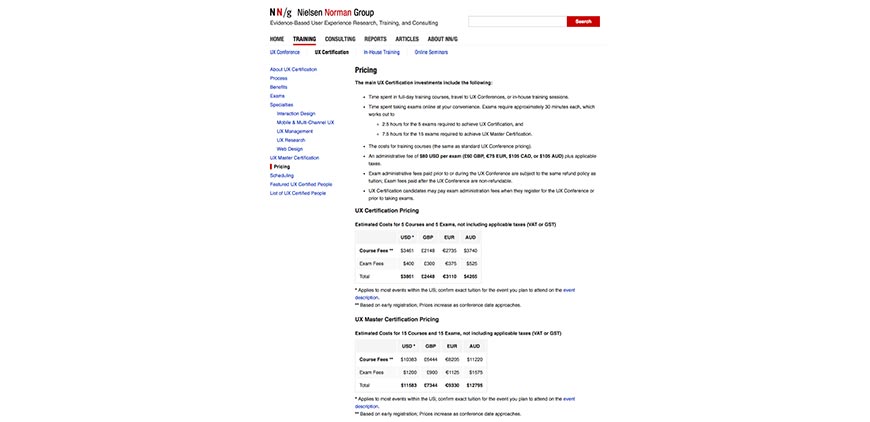
The Nielsen Norman Group (NN/g) has been the authority in UX research and usability since 1998, and the NN/g UX Certification is the closest thing the field has to a gold standard. The format has changed since the original version of this list: today the certificate is built course by course, with each course running roughly $1,100 and each exam $80.
To earn the base UX Certificate you complete five full-day courses and pass the corresponding exams. The Master Certification adds a deeper requirement and currently runs around $18,100 if you complete it from scratch, with most professionals stretching the work over a year or two.
NN/g also added four optional specialty tracks that you can attach to your certificate by taking five courses in one focus area: Artificial Intelligence, Interaction Design, UX Research, and UX Management. The specialty model is a meaningful upgrade for mid- and senior-level UXers who want a recognized credential in a specific domain rather than another general certificate.
Courses are offered live online and in person at NN/g’s UX Conferences in major cities. NN/g also delivers on-site team training for organizations.
2. Human Factors International
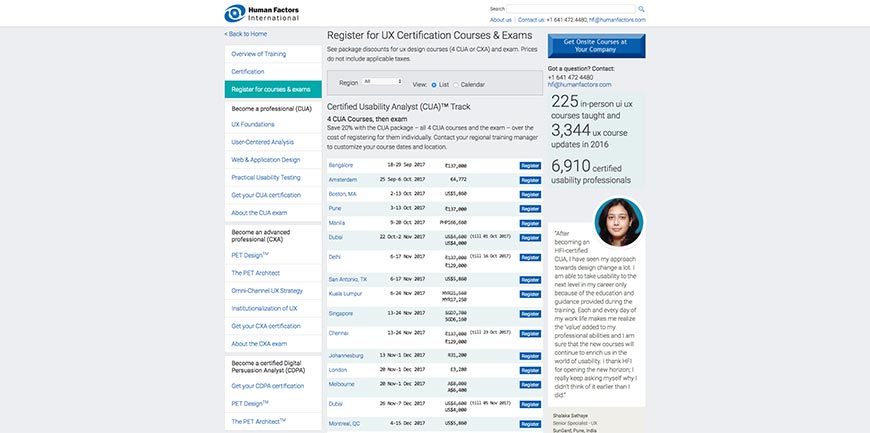
Human Factors International (HFI) has been training UX professionals since 1981 and is the home of the Certified Usability Analyst (CUA) credential, one of the longest-running professional certifications in the field.
The full CUA Track currently bundles four courses for $4,980 and is targeted at practitioners who want a foundation in user-centered analysis, web and app design, and usability testing. The CUA exam itself runs $800 and is offered several times a year. You can also sit the exam without taking the courses if you have the experience to back it up.
HFI also runs a more advanced Certified User Experience Analyst (CXA) credential for practitioners who already hold the CUA and want to demonstrate strategic UX maturity. Together, CUA and CXA give HFI a clear ladder for people who plan to stay in usability and UX research roles long-term.
3. The Team W / Weinschenk Institute
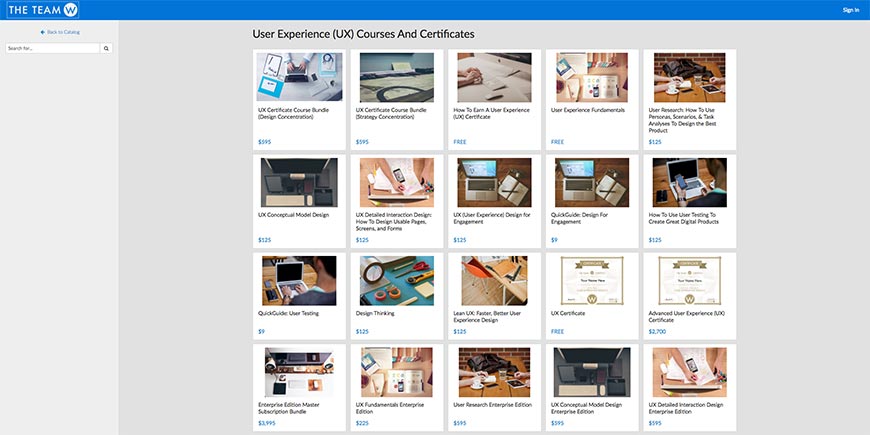
Dr. Susan Weinschenk, also known as The Brain Lady, runs The Team W’s online UX program, with a particular focus on the behavioral science behind why users actually do what they do.
The catalog now organizes its work into themed certificate bundles: UX Design, UX Strategy, UX Methods, and the Advanced UX Certificate, which adds one-on-one mentoring with Dr. Weinschenk. Individual courses range from free to a few hundred dollars, with full bundles in the low- to mid-thousands depending on the track.
This is the right pick for practitioners who want behavioral psychology and persuasion design in their UX toolkit, and for anyone who values self-paced, asynchronous learning over fixed cohort schedules.
4. UCLA Extension
The UCLA Extension User Experience Certificate is a strong replacement for the older San Francisco State Mobile UX Intensive, which was discontinued. UCLA’s program runs through the Design Communication Arts department and covers UX, UI, product design, and AI-assisted design tools across a four-course sequence (User Experience I through IV) plus electives and a capstone.
The program is online and quarter-based, designed for working professionals and career changers. It culminates in a portfolio capstone that gives you something concrete to show employers. Pricing is per course rather than a flat program fee; expect to budget several thousand dollars across the full sequence depending on which electives you take.
UCLA Extension is recognized in California’s tech and entertainment industries, and the program’s emphasis on AI-powered design tools (Figma AI features, Midjourney for ideation, AI-assisted research synthesis) is one of the better attempts among university extensions to keep curriculum current.
5. Udemy — UX & Web Design Master Course
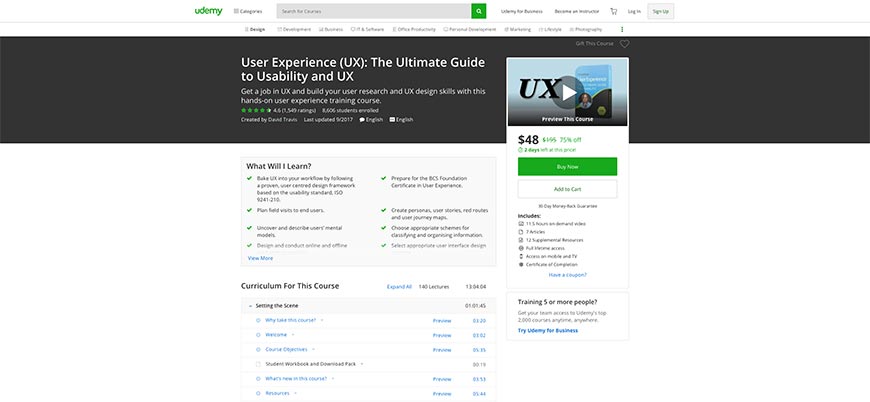
Udemy is the largest open marketplace for UX courses, and Joe Natoli’s UX & Web Design Master Course is the bestseller most often recommended for self-starters. The course frames UX through Jesse James Garrett’s five planes of experience — Strategy, Scope, Structure, Skeleton, and Surface — and includes about a dozen hours of video plus exercises.
List price is around $90 to $150, but Udemy runs aggressive discounts and the course is regularly available for under $20. You receive a certificate of completion, lifetime access to the material, and updates as Joe revises the content.
This is not a credential that will impress an enterprise hiring manager, but it is an effective and inexpensive way to learn the vocabulary and the underlying frameworks if you are completely new to UX. Pair it with one of the structured certificates lower in this list once you have decided UX is the field for you.
6. Designlab UX Academy
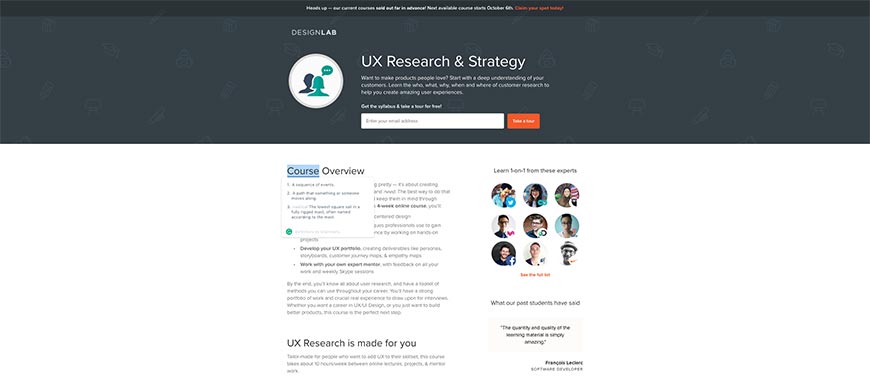
Designlab has evolved from a handful of short courses into one of the most polished UX bootcamps on the market. The flagship UX Academy is a 21-week full-time or 36-week part-time program that pairs project-based learning with weekly one-on-one mentor sessions and group critique. Tuition is currently $8,499, with a $400 servicing fee for monthly payment plans.
If UX Academy feels like too big a jump, UX Academy Foundations is a $499 prerequisite-style course that introduces the design process, visual fundamentals, and Figma. The $499 you pay for Foundations transfers as credit toward UX Academy tuition if you continue.
Designlab leans heavily on portfolio outcomes. Their career services team will not promise a job, but the structured case studies students produce are some of the better-looking portfolio pieces a beginner can put on the table at the end of a six-month program.
7. Coursera
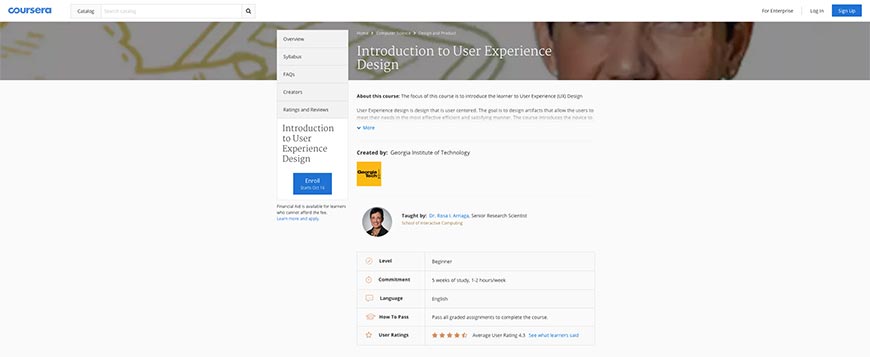
Coursera’s catalog is enormous, but two programs are worth singling out. The Google UX Design Professional Certificate is now the headline UX program on the platform. It is a seven-course beginner program that more than 650,000 learners have enrolled in since its 2021 launch. Total cost runs about $39 per month, and most learners finish in three to six months for $120 to $234.
What makes the Google certificate work is the portfolio output: each course ends in a peer-reviewed project, so by the end you have three full case studies plus access to the Google Career Certificates Employer Consortium, a group of 150-plus companies that have committed to considering certificate holders for entry-level roles.
If you want a free option, Coursera also still offers individual UX courses such as the University of Michigan’s Introduction to User Experience Design, which can be audited for free with the certificate available for a small fee. That is a good no-cost on-ramp before you commit to the longer Google sequence.
8. General Assembly
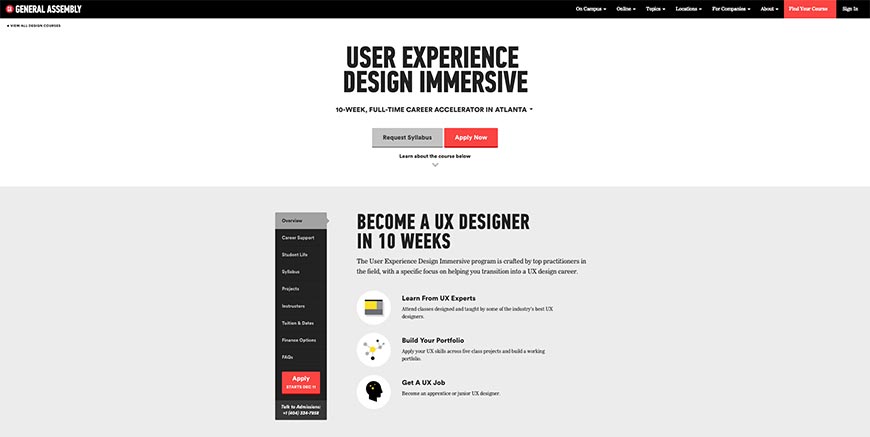
General Assembly’s UX Design Immersive is one of the original premium UX bootcamps. The full program runs 12 weeks full-time or about six months part-time, and the published price is $14,960. GA offers payment plans (three installments of $4,984), scholarships for underrepresented groups, and loan financing.
The format is intense: full days of lectures, studio work, group critique, and capstone projects. GA’s career services team places graduates at companies through its hiring partner network, and the program’s reputation is strong enough that GA alumni are visible on UX teams at most major tech companies.
This is not the place to start if you are unsure UX is for you. It is the right pick if you are committed to a career change and you want the most concentrated, structured route through the foundations.
9. Interaction Design Foundation (IxDF)
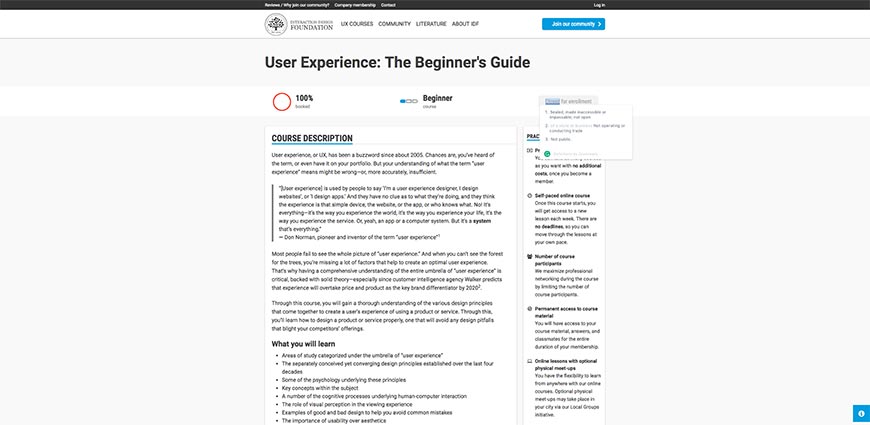
The Interaction Design Foundation, now branded as IxDF, is the largest subscription learning library in UX. Membership unlocks the full course catalog, which has grown to dozens of courses across UX, UI, design thinking, accessibility, and HCI.
Pricing is membership-based and has shifted to monthly billing: roughly $22 a month for a Professional membership and $15 a month for students, both billed annually. There is also a much pricier Design League tier that adds personal coaching and intensive support.
What you actually get is unlimited access to courses and an industry-recognized certificate for each one you complete and pass. IxDF certificates carry less weight in US hiring than NN/g or Google, but the depth of the catalog and the price-per-course make it the best value on this list for self-directed learners who plan to take many courses over a year or two.
10. Bentley University's User Experience Center
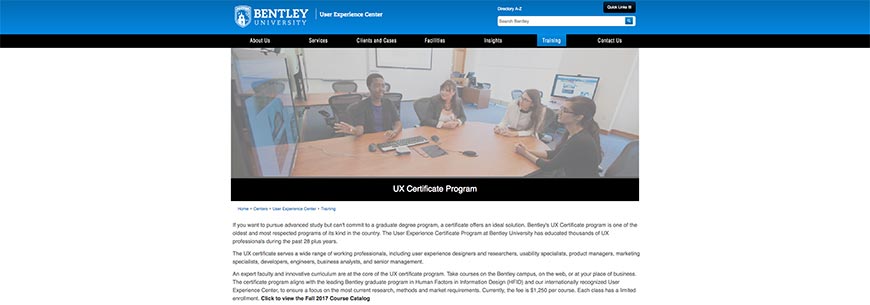
Bentley’s UX Certificate Program is the oldest of its kind in the United States, and the curriculum has been refreshed for 2026 to require eight courses: five required (Experience Design Career Visioning & Strategy; Human Factors and Experience Design; The Business of Experience Design; The Experience Design Process; Inclusive, Ethical, and World-Ready Experiences) plus three electives of your choice.
Classes mix in-person sessions on the Bentley campus with online formats, and the program is designed for working professionals who can commit to one or two courses per term. Bentley also runs a UX Boot Camp variant for people who want a faster, more concentrated track.
The certificate is well-respected in the Boston-area enterprise market, and the inclusion of Inclusive, Ethical, and World-Ready Experiences as a core course makes Bentley one of the few university programs that has formally folded accessibility and ethics into its required curriculum.
11. SMU CAPE
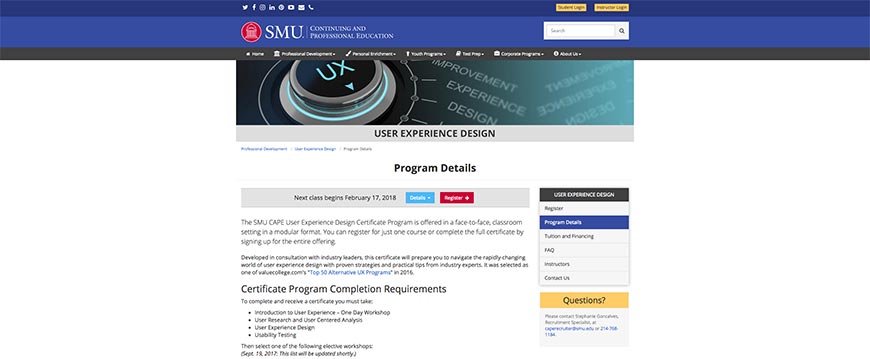
Southern Methodist University’s Continuing and Professional Education program offers a User Experience Design Certificate that you can finish in as little as six months. Classes are scheduled in the evenings and on weekends, and the program is offered in both online and in-person formats on the SMU campus in Dallas.
The curriculum is project-based: students work on real-client briefs through the program and ship a capstone portfolio piece at the end. Graduates earn a digital badge through Credly that can be added to LinkedIn and a resume.
SMU’s program is a good fit for working professionals in the Dallas–Fort Worth area, or for anyone who wants a university-affiliated certificate without the application requirements of a graduate program. Pricing varies by intake; check the current schedule for the active rate.
12. CareerFoundry
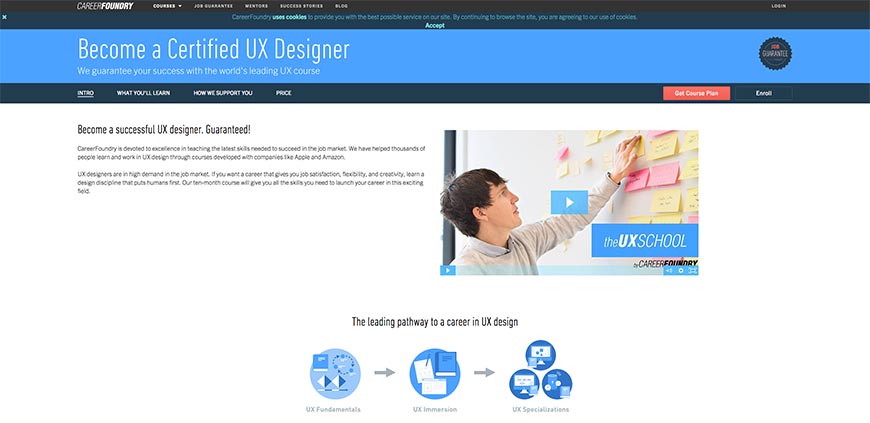
CareerFoundry’s UX Design Program is one of the best-known online UX bootcamps with a job guarantee. The headline promise: complete the program and meet the career-services requirements, and if you do not land a UX role within 180 days of graduation, CareerFoundry refunds your tuition.
The course pairs structured curriculum with a dedicated mentor and career coach, both assigned at intake. Students work through eight to ten months of part-time study, build five full case studies for their portfolio, and finish with a job-search sprint supported by CareerFoundry’s hiring partners.
The job guarantee comes with strict eligibility requirements (full completion, passing capstone, active participation in career services), so read the contract carefully. If you are a career changer who wants accountability and a real safety net, CareerFoundry is one of only a handful of programs willing to put their tuition where their marketing is.
13. UC San Diego Extension
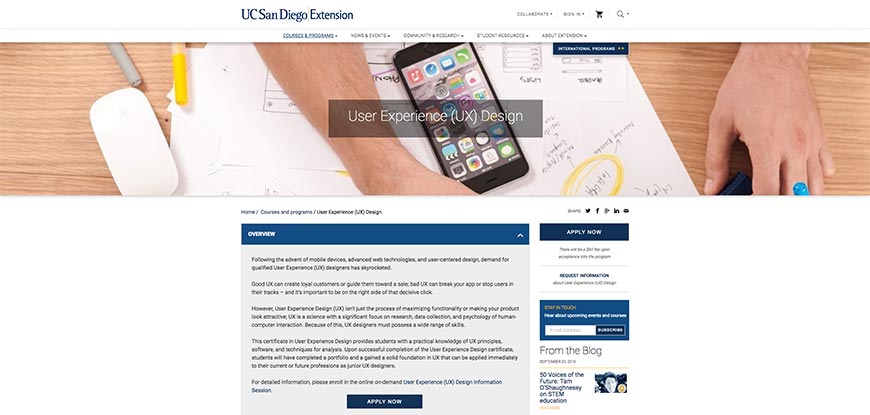
UC San Diego’s Division of Extended Studies offers an asynchronous online User Experience Design Certificate that consists of four required core courses, two UX design electives chosen from a catalog of around sixteen, and a final portfolio course.
Courses run quarterly and most students complete the certificate over five to eight quarters by taking two courses at a time. Course pricing varies; expect a total program cost in the mid-thousands plus a small administration fee. Some electives require an Adobe Creative Cloud subscription.
The fully online format is a major advantage for working professionals or anyone outside Southern California. UCSD also runs free one-on-one information sessions for prospective students; book one before you commit if you want a clearer picture of the time and cost involved.
Full-Time and Graduate Certificate Programs
14. University of Washington

The University of Washington’s Department of Human Centered Design & Engineering runs a Graduate Certificate in User Centered Design, a five-course (15-credit) evening program completed over one academic year. Classes meet on the Seattle campus, typically 6 to 9:50 p.m., Monday through Thursday.
Admission is selective and graduate-level. Applicants need a four-year bachelor’s degree from an accredited institution and a minimum of two years of full-time work experience in a related field. The 2026–2027 cohort starts September 30, 2026; applications open April 1, 2026, with a priority deadline of May 1 and a final deadline of August 1.
Tuition for 2025–2026 is $998 per credit, plus a $90 application fee and a $55 quarterly registration fee. That puts total program cost in the $15,000 range. Of every entry on this list, this is the closest thing to a graduate-school credential, and HCDE alumni are strongly represented at companies like Microsoft, Amazon, Google, and Boeing.
15. CSU Fullerton

If you do not have the bachelor’s-plus-experience profile that UW requires but still want a structured year-long program, the CSU Fullerton UX Certificate is a strong alternative. The program walks students through the full UX lifecycle in five courses: Introduction to UX and UX Research; Analysis and Planning for User-Centered Design; User-Centered Design for Web and Mobile Interfaces; Prototyping User-Centered Design Solutions; and Concepts and Practices in Usability Testing, plus a final portfolio course.
Most of the program is delivered online, with some in-person options. Each course is priced individually, with the full certificate typically completed in three to nine months depending on pace. Expect a total program cost in the low-thousands range.
CSU Fullerton’s program is a good fit for Southern California learners who want a Cal State–branded credential, and for anyone who wants a portfolio-output-focused certificate without the academic-admissions hurdle of a graduate program.
How to Pick the Right UX Certification
The best program for you depends on three things: where you are in your career, how much time and money you can invest, and what you want the credential to do for you.
- Complete beginner exploring whether UX is for you: Start with the Google UX Design Certificate or an IxDF membership. Both are inexpensive enough that you can quit if it is not for you, and both produce real portfolio work.
- Career changer who needs structured accountability: CareerFoundry, Designlab UX Academy, or Springboard. The mentor relationship and career services are worth the higher price.
- Working professional adding UX to an existing role: A subscription to IxDF for breadth, plus one or two NN/g courses in your specialty for depth. Bentley and SMU are also good fits if you prefer a university-affiliated credential.
- Mid-level UXer specializing in research: NN/g UX Research specialty track, or HFI’s CUA followed by CXA. These are the credentials hiring managers in research-heavy organizations actually recognize.
- Mid-level UXer moving toward management: NN/g UX Management specialty track, plus targeted reading rather than a second certificate.
- Career changer with employer tuition support or an academic preference: University of Washington’s HCDE certificate, Bentley, or General Assembly’s Immersive. Use the budget while you have it.
The thread that runs through all of these recommendations: pick the program that forces you to ship portfolio work. If a program does not produce a case study, a research artifact, or a prototype that you can show in an interview, it is not pulling its weight.
Frequently Asked Questions
Are UX certifications worth it in 2026?
Yes for career changers and entry-level candidates, where a structured certificate fills a credibility gap and forces portfolio output. Less so at mid-level and above, where what you have shipped matters more than the credential. The exception is NN/g specialty tracks, which are recognized at most levels of seniority.
What is the best UX certificate for beginners?
The Google UX Design Professional Certificate on Coursera is the most-cited option for beginners: low cost (about $234 over six months), a recognized name, and three case studies you can put in a portfolio. Interaction Design Foundation membership is the next-best alternative for self-paced learners.
How long does it take to get UX certified?
It depends on the program. The Google UX Design Certificate runs three to six months at ten hours a week. NN/g’s UX Master Certification typically takes one to two years across multiple courses. University extension certificates and graduate certificates are usually structured around a one-year academic schedule. Bootcamps like Designlab UX Academy, General Assembly, and CareerFoundry run six to ten months.
Do UX certifications expire?
Most do not. NN/g, Google, IxDF, Bentley, Cornell, and the major university certificates are all permanent credentials. NN/g recommends ongoing professional development but does not require formal recertification.
Is the Google UX Design Certificate enough to get a UX job?
On its own, no — but combined with a strong portfolio of case studies, it is. The certificate forces you to produce three portfolio pieces, and admission to the Google Career Certificates Employer Consortium gives you a small but real hiring tailwind. Plan to supplement it with at least one self-initiated portfolio project beyond the course assignments.
NN/g vs IxDF vs Google — which should I pick?
Google for the lowest cost and the broadest recognition among entry-level employers. IxDF for breadth at a low monthly price if you plan to work through many courses. NN/g for depth and credibility at mid- and senior-level, especially in UX research, AI, interaction design, or UX management specialty tracks.
Can I get a UX job without any certification at all?
Yes. A strong portfolio with two or three thoughtful case studies, a clear written process, and a few user-research artifacts will outperform a certificate-only resume. The fastest no-certificate route is to volunteer for a real project, run a small redesign on a public-domain site, or take an existing app and document a complete redesign with usability testing.
Bottom Line
UX hiring in 2026 is portfolio-first, and no certificate on this list will get you hired on its own. The right one at the right moment, however, gives structure to your studies, fills a credibility gap when your portfolio is still thin, and forces you to ship the case studies that do most of the work in interviews.
If you are a beginner, the Google UX Design Certificate is the cheapest reasonable starting point. If you are a career changer with budget, CareerFoundry, Designlab UX Academy, or General Assembly will give you a structured path. If you are already working in UX and want recognized depth, NN/g’s specialty tracks are still the field’s gold standard. The university certificates from Bentley, UW, UCSD, UCLA, SMU, and CSU Fullerton are strong choices when you want academic rigor or your employer is paying.
Whichever you pick, prioritize the program that forces you to produce real, testable, portfolio-ready work — that is what will actually move the needle on your next role.