
Each entry below links to the tool’s current home page (verified April 2026). Where a tool has been renamed, acquired, or archived since this list was first published in 2018, the change is called out in line.
1. REST-Assured
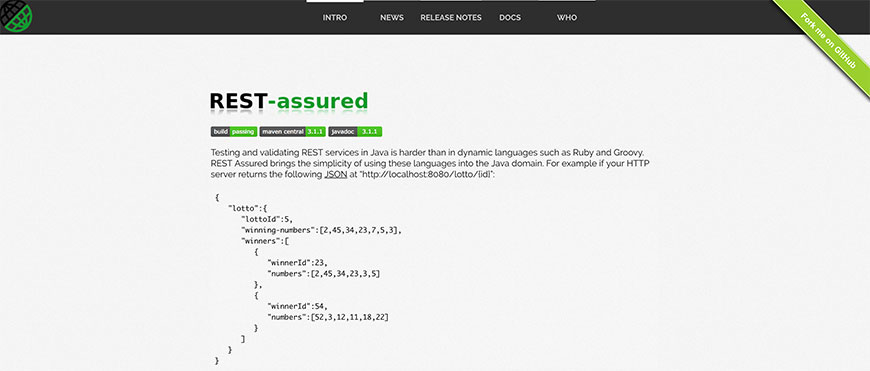
REST-Assured is a Java DSL for testing REST services that has stayed actively maintained on GitHub since 2010 (current line is 5.x). It removes the boilerplate normally needed to call HTTP endpoints from Java code, and supports a Given/When/Then structure that reads well in JUnit and TestNG. JSON and XML response bodies can be matched with JsonPath and XmlPath, and OAuth2, basic auth, and certificate auth are first-class. It pairs naturally with Maven or Gradle and slots into Jenkins, GitHub Actions, or any other CI runner. For Java teams who want their API tests next to their unit tests, REST-Assured is still the obvious starting point.
2. Postman
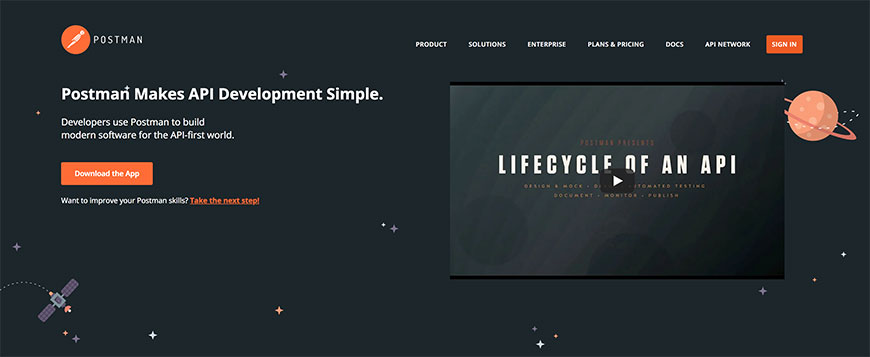
Postman has grown from a Chrome extension into a full API platform with desktop apps for Mac, Windows, and Linux, a web client, and a hosted workspace product used by tens of millions of developers. The core experience — build a request, see the response, save it to a collection, run the collection — is unchanged, but it now sits next to environments, monitors, mock servers, contract testing, and built-in OpenAPI authoring. The free tier is generous; the paid plans add team workspaces and SSO. For exploratory testing, request sharing, and basic CI runs (via Newman or the Postman CLI), it is the default tool most teams reach for.
3. SoapUI
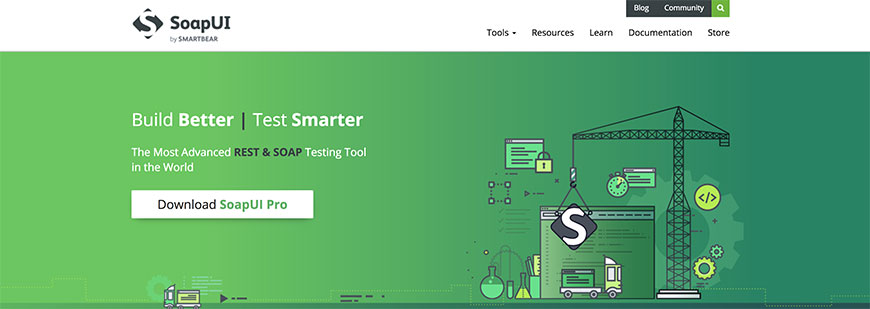
SoapUI from SmartBear is the long-running open-source standard for SOAP testing and remains a strong choice for any team that has to talk to enterprise SOAP services. The free version handles drag-and-drop test creation, mocking, and Groovy scripting; the commercial counterpart, ReadyAPI, layers on data-driven testing, security scanning, and a richer reporting layer. SoapUI also covers REST, GraphQL, and JMS, which makes it useful in shops that mix legacy and modern protocols. If your stack has any WSDL or WS-* in it, SoapUI is hard to avoid and easy to recommend.
4. Apache JMeter
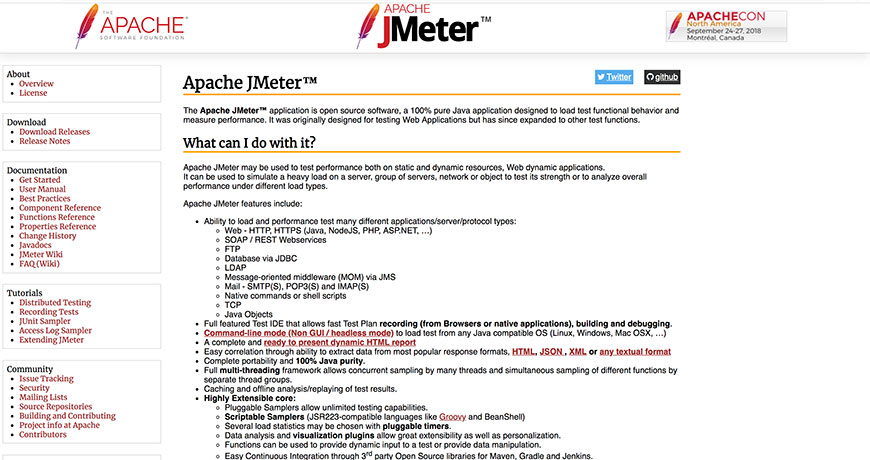
JMeter started as a load-testing tool and has expanded into a general-purpose protocol tester. It speaks HTTP, FTP, JDBC, JMS, LDAP, SMTP, and more, and can drive both functional and performance tests from the same scripts. The GUI is showing its age, but the underlying engine is still excellent for high-throughput load runs, and the CSV-driven parameterization is well suited to data-heavy API tests. Plugins and the Taurus YAML wrapper smooth out the rougher edges. For teams that want one tool that does both functional API tests and serious load tests on the same JVM, JMeter is still the default open-source choice.
5. Karate
Karate (formerly KarateDSL) has matured into one of the most popular open-source API automation frameworks, with active commercial backing from Karate Labs. Tests are written in a Cucumber-style Gherkin DSL, but you do not need to write step definitions — the framework ships with everything. The same script can drive REST, GraphQL, gRPC, browser tests via Playwright, and load tests via Gatling. It is a strong fit for teams who want one syntax across API and end-to-end testing, and the documentation is unusually good for an open-source project of its size.
6. Fiddler / Fiddler Everywhere
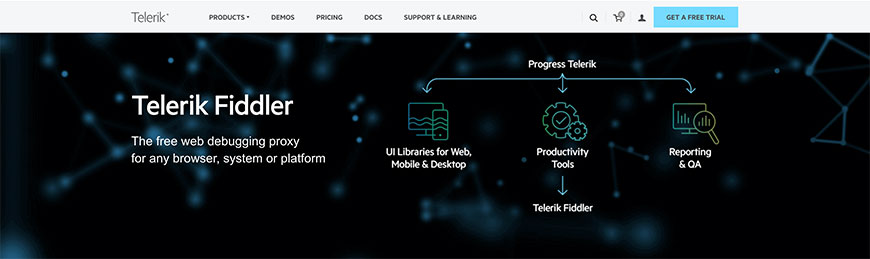
Fiddler from Telerik (now part of Progress) is a proxy that sits between your client and the network and gives you full visibility into HTTP and HTTPS traffic. The classic Windows-only Fiddler Classic is still free; Fiddler Everywhere is the modern cross-platform paid version with composer, scripting, and team sharing. Either tool is invaluable when you need to see exactly what a third-party SDK or mobile app is sending, modify a request mid-flight, or replay a captured call. It is a debugging tool first and a test tool second, but no API tester should be without one of these in their kit.
7. HttpMaster Express
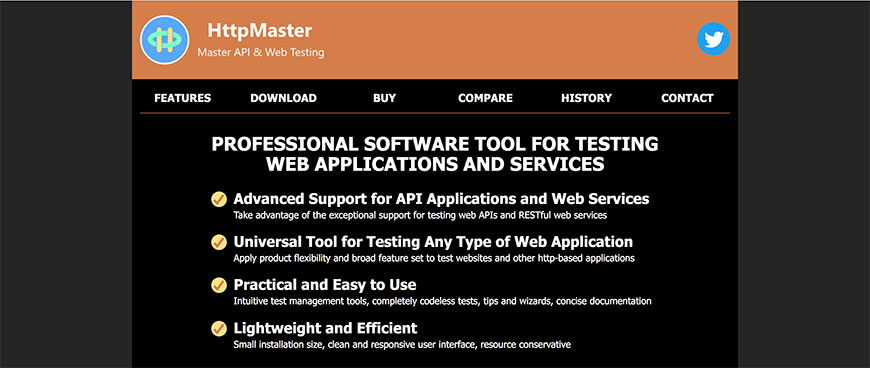
HttpMaster Express is a Windows-focused API and web testing tool aimed at smaller teams that want a single desktop app rather than a full framework. It supports the standard REST verbs plus custom ones, can import and run OpenAPI/Swagger projects, and includes a request data builder, response viewer, and command-line runner for batch execution. Global parameters and dynamic data make it easy to chain calls across an entire test suite. For QA professionals on Windows who do not want to write code to test an API, HttpMaster remains a practical option.
8. RestSharp

RestSharp is the long-standing HTTP client library for .NET. It supports synchronous and asynchronous calls, automatic JSON and XML serialization, and authentication including OAuth1, OAuth2, basic, and bearer tokens. Recent releases (v110+) have modernized the API around HttpClient and async/await, and the library is fully compatible with .NET 6, 8, and 9. For any C# or F# team that wants a more ergonomic surface than raw HttpClient, RestSharp is still the default. It works well as the request layer behind xUnit or NUnit-based API test suites.
9. Insomnia
Insomnia, maintained by Kong, is the closest open-source equivalent to Postman and a strong fit for teams who want a leaner, file-based workflow. It supports REST, GraphQL, gRPC, WebSockets, and Server-Sent Events out of the box, with environment variables, scripting, and OpenAPI-driven design. The free desktop app handles individual workflows; the team plan adds Git sync, role-based access, and enterprise SSO. For developers who left the Advanced REST Client (which Google archived in 2024) looking for a replacement, Insomnia is the most natural landing spot.
Replaced Rest Console (Advanced REST Client) in this list — ARC was archived in May 2024.
10. Mockoon
Mockoon is a free, open-source desktop application for creating mock REST APIs in seconds. You define routes, status codes, headers, and response bodies in a clean GUI, and the local server starts on a port you choose. It also has a CLI and a Docker image, which makes it trivial to run a mock backend in CI or in a developer’s local Docker Compose stack. Templating with Faker.js produces realistic-looking response data, and the OpenAPI import lets you spin up a mock from an existing spec. For any team waiting on a backend service to ship, Mockoon eliminates the wait.
Replaced RoboHydra Server in this list — RoboHydra has not had a meaningful release since 2014.
11. Schemathesis
Schemathesis takes an OpenAPI or GraphQL schema and generates property-based tests against your real API to surface schema violations, crashes, and security issues. It is the modern answer to “does my running service actually match the contract I published?” Test cases are derived from the schema using Hypothesis-style generators, which means you get coverage of edge cases you would not write by hand. It can be run from the command line, as a pytest plugin, or in CI, and it integrates with Stoplight, Postman, and Pact. For any API published with an OpenAPI document, Schemathesis is one of the highest-leverage testing tools you can add.
Replaced Hippie-Swagger in this list — Hippie-Swagger has been near-inactive since 2019.
12. k6 by Grafana
k6 (now part of Grafana Labs) is the modern open-source load testing tool that has steadily added functional API testing, browser testing, and chaos features. Tests are written in JavaScript or TypeScript and executed by a Go runtime that scales to hundreds of thousands of virtual users on a single machine. It plugs into Grafana dashboards for results, runs cleanly in CI, and has a hosted SaaS (Grafana Cloud k6) for distributed runs. For teams that want both functional API checks and serious load tests with the same script, k6 has become the de facto choice.
Replaced WebInject in this list — WebInject’s last release was in 2014.
13. Tavern
Tavern is a Python framework for testing REST and MQTT APIs declaratively in YAML. Each test step is an HTTP request and a set of assertions; the framework handles fixture setup, environment variables, and JSON path matching. It runs as a pytest plugin, which means everything you already use with pytest — parametrize, marks, fixtures, parallel execution, reporting — just works. It is a strong fit for teams that want test files non-developers can read and edit, while still benefiting from the pytest ecosystem on the runner side.
Replaced PyRestTest in this list — PyRestTest has been archived since 2017.
14. Bruno
Bruno is a newer, fast-growing open-source API client built around a plain-text, git-friendly file format (.bru files). Where Postman keeps state in a hosted workspace, Bruno keeps it next to your code in a folder you can version, branch, and review. The desktop app is free, supports REST, GraphQL, and gRPC, and runs scripts written in JavaScript. It also has a CLI for CI runs. For developers who want their API requests in the same repo and code review flow as their code, Bruno has become the obvious choice.
Replaced Airborne in this list — Airborne’s last meaningful update was in 2019.
15. Unirest
Unirest is a lightweight HTTP client library now maintained under the Kong umbrella. It offers a consistent, fluent API for making HTTP calls across multiple language ecosystems — the Java, Node.js, Python, PHP, .NET, and Ruby implementations all expose a recognizably similar surface. That makes it useful in polyglot teams that want their API test code to look the same regardless of the language under test. Unirest is not a full test framework; it is the request layer you bolt onto JUnit, pytest, Mocha, or whatever runner you already use.
16. Beeceptor
Beeceptor is a hosted HTTP mocking and request-inspection service that you can stand up in seconds without installing anything. Each named endpoint gets its own URL that returns whatever response you configure; webhooks and proxy modes let you capture and replay real traffic. It is especially handy for testing third-party integrations, debugging webhooks, and sharing a stable mock URL with another team. There is a free tier for ad-hoc use and paid plans for higher request volumes and team features.
Replaced Mockbin in this list — Mockbin (Kong/Mashape) was archived several years ago.
17. Citrus Framework
Citrus is an open-source integration testing framework for messaging-heavy systems. It can drive HTTP, SOAP, JMS, Kafka, AMQP, FTP, and database calls from a single test, and validate JSON, XML, and binary payloads against expected templates. Tests can be authored in Java or in XML, and the framework is at home in either JUnit/TestNG or Cucumber. For teams whose architecture is built on message brokers as much as on REST endpoints, Citrus does work that the more REST-focused tools on this list cannot.
18. Selenium
Selenium is the long-standing open-source browser automation framework, now governed by the Selenium project at selenium.dev. It is technically a UI tool, not an API tool, but it shows up here because so much real-world API testing happens through a browser — OAuth flows, single-page apps, file uploads, third-party widgets. Selenium 4 brought the W3C WebDriver protocol, native relative locators, and improved Grid. For teams that want their end-to-end coverage to also exercise the underlying APIs through a real browser, Selenium remains the standard.
19. Katalon Platform
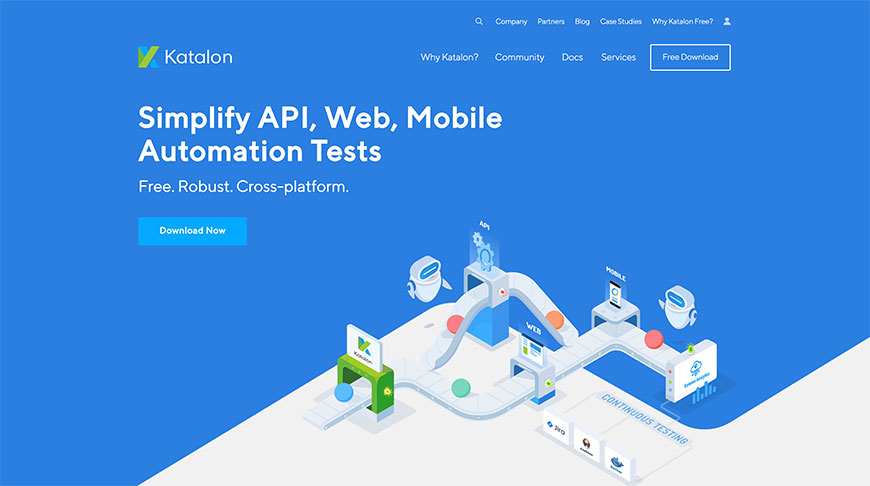
Katalon, formerly Katalon Studio, is a commercial test automation platform built on top of Selenium and Appium. It packages browser, mobile, and API testing in one IDE, with both record-and-playback and scripted modes (Groovy under the hood). Recent releases have leaned into AI-assisted test generation and a SaaS dashboard, Katalon TestOps, for cross-suite reporting. For teams that want one product to cover web, mobile, and API — and who do not want to assemble that stack from open-source pieces — Katalon is the most common choice.
20. OpenText UFT One
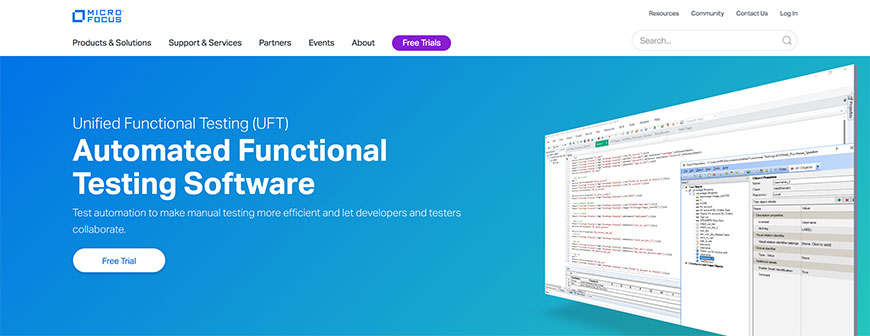
UFT One — originally HP UFT, then Micro Focus UFT, and now OpenText UFT One after the 2023 OpenText acquisition of Micro Focus — is an enterprise functional and regression testing tool for desktop, web, mobile, and API. It supports both keyword-driven and scripted (VBScript) authoring, image-based and AI-based object recognition, and integration with Jenkins and OpenText’s broader application delivery suite. It is a strong fit for large enterprises with a mix of legacy desktop apps and modern web apps; it is heavier than most other tools on this list and priced accordingly.
21. Watir

Watir (Web Application Testing in Ruby) is the long-running Ruby wrapper around Selenium WebDriver. It supports all current browsers via the W3C WebDriver protocol and integrates cleanly with RSpec, Cucumber, and Test::Unit for BDD-style API and end-to-end suites. For Ruby shops, the library reads and feels much more idiomatic than calling raw Selenium bindings. The project remains actively maintained at watir.com.
22. HCL OneTest UI (formerly IBM Rational Functional Tester)

The product formerly known as IBM Rational Functional Tester has been part of HCL Software since the 2018 IBM-HCL transaction, and now ships as HCL OneTest UI alongside HCL OneTest API and HCL OneTest Performance. It supports Java, .NET, SAP, Flex, and AJAX applications and offers a Storyboard view that records sessions in natural language with screenshots. ScriptAssure handles the brittle-locator problem by adapting to UI changes between runs. It is a serious enterprise option for teams already invested in the HCL or former IBM Rational/Jazz toolchain.
23. TestComplete
TestComplete from SmartBear is a commercial UI and API automation tool with both keyword-driven and scripted (Python, JavaScript, VBScript) modes. It offers AI-driven object recognition, scriptless record-and-playback, and tight integration with Selenium, Jenkins, and the rest of the SmartBear suite (including SoapUI/ReadyAPI for API). It is most often paired with QAComplete or Zephyr for test management. For teams who want a polished, supported alternative to the open-source Selenium-plus-glue path, TestComplete is the standard pick.
24. Keysight Eggplant
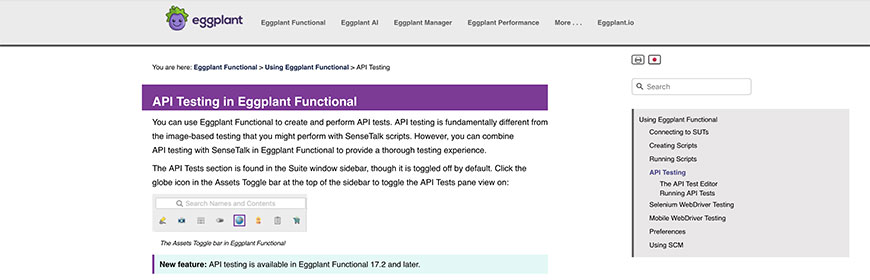
Eggplant — acquired by Keysight in 2020 — takes an unusual image- and AI-driven approach to testing. Rather than locate elements via DOM selectors, Eggplant Functional drives the application visually, the way a person would, which lets it test desktop, mobile, web, embedded systems, and even physical devices through a camera feed. Eggplant Performance handles load testing, and Eggplant DAI applies machine learning to test case generation and failure analysis. It is a niche tool with a high price tag, but for cross-platform and embedded scenarios it does work that the more conventional tools on this list cannot.
25. Tricentis Tosca
Tricentis Tosca is a model-based test automation platform aimed squarely at the enterprise Agile/DevOps audience. Tests are designed as reusable modules tied to a model of the application, which makes test maintenance dramatically cheaper as the underlying UI or API changes. It supports SOAP, REST, web, mobile, SAP, Salesforce, ServiceNow, and a long list of packaged enterprise apps. Tosca’s risk-based test optimization — picking the smallest test set that covers the largest risk surface — is its standout feature. It is a heavy commercial tool, used mostly by larger organizations.
26. Ranorex Studio
Ranorex Studio is a Windows-based commercial test automation tool covering desktop, web, and mobile. It targets QA teams who want an IDE-driven experience rather than a code-first one: scriptless record-and-playback, a strong object repository, reusable code modules, and a clean reporting view with screenshots. Underneath, scripts are C# or VB.NET, so experienced engineers can drop into code where they need to. Ranorex integrates with Jenkins, Azure DevOps, Bamboo, and Jira, and pairs well with BrowserStack or Sauce Labs for cross-browser runs.
27. Robot Framework

Robot Framework is an open-source, keyword-driven generic testing framework that has only grown in popularity since 2018. Its plain-text syntax makes tests readable to non-programmers, and the rich library ecosystem — SeleniumLibrary, RequestsLibrary, AppiumLibrary, DatabaseLibrary, and many more — means you can drive almost anything from the same suite. For teams that want a single testing language across web, API, and mobile, with a low barrier for QA engineers without a programming background, Robot Framework is one of the strongest open-source choices available.
28. Dredd

Dredd is a command-line tool that takes an API description (API Blueprint or OpenAPI 2.0) and exercises a running implementation against it, failing the build when responses do not match the documented contract. Hooks let you set up and tear down state around each request, and the tool integrates cleanly with CI runners. Dredd has not seen the same growth as Schemathesis, but for teams who already use API Blueprint or whose contracts are stable, it remains a small, focused, dependable option for documentation-driven testing.
29. Stoplight Prism
Stoplight Prism is an open-source HTTP mock server and validation proxy built around OpenAPI. Point Prism at a spec and it stands up a mock server that returns examples (or generated data) for every operation, validates incoming requests, and contract-checks proxied responses. It runs as a CLI, a Docker image, or a Node library, which makes it easy to drop into local development and CI. Stoplight’s design tools (Studio and Spectral) round out the picture for teams who want a contract-first workflow.
Replaced Swagger Test Templates in this list — the original Apigee resource is no longer maintained.
30. PactumJS
PactumJS is a modern open-source REST API testing tool for Node.js that ties together functional, contract, and component testing. It runs as a Mocha or Jest plugin, supports clean Given/When/Then chaining, includes a built-in mock server, and can do consumer-driven contract testing with Pact-style interactions. Snapshot testing and matcher functions cover the cases where exact response bodies change between runs. For JavaScript and TypeScript teams who want something more powerful than raw supertest but lighter than Postman/Newman, PactumJS is a strong fit.
Replaced Chakram in this list — Chakram has been archived since 2019.
How to Pick the Right Tool
The names above sort cleanly into four groups, and most real-world setups end up using one from each:
- API clients (exploratory + manual): Postman, Insomnia, Bruno, Fiddler.
- Automation frameworks (CI-friendly): REST-Assured, Karate, Tavern, PactumJS, Robot Framework, k6, JMeter, RestSharp, Citrus, Watir, Selenium-based suites (Katalon, TestComplete, Ranorex, OpenText UFT One, HCL OneTest UI).
- Mocking and stubbing: Mockoon, Beeceptor, Stoplight Prism, the mock features in Postman and SoapUI.
- Contract / spec validation: Schemathesis, Dredd, Stoplight Prism, the contract features in PactumJS and Postman.
For most teams shipping a typical web app in 2026, the pragmatic stack is: Postman or Bruno for exploration, REST-Assured/Karate/PactumJS for automated functional tests in CI, k6 for load, Mockoon or Prism for local development against unfinished services, and Schemathesis on the OpenAPI contract.
FAQ
What is the best free API testing tool in 2026? For most users, Postman’s free tier remains the easiest place to start. Insomnia and Bruno are the strongest open-source alternatives. For automated tests in CI, REST-Assured (Java), Karate (any JVM), Tavern (Python), and PactumJS (Node) are all free and widely used.
Has AI changed API testing? Yes, but mostly at the edges. AI-assisted test generation in Katalon, TestComplete, Eggplant DAI, and Postman’s AI features can scaffold tests faster, but the assertions and expectations still need a human to confirm. Property-based and schema-driven tools like Schemathesis arguably do more for coverage than any of the AI features.
Are Postman and Insomnia interchangeable? They overlap heavily for individual use. They diverge on team workflow: Postman pushes a hosted workspace and account model; Insomnia is more file- and git-friendly. Bruno takes the file-based approach further. Pick based on whether your team wants its API requests living in the cloud or in the repo.
What about overlay-style tools that promise no-code API testing? Most modern enterprise tools (Katalon, Tosca, TestComplete, OpenText UFT One, Ranorex) include record-and-playback and scriptless modes. They work for stable UIs and well-known endpoints but tend to break under heavy refactors. The healthiest pattern is scriptless authoring for QA engineers plus a code escape hatch for engineers — which is what most of these products now offer.
How do I test GraphQL or gRPC APIs? Postman, Insomnia, Bruno, k6, and Karate all support GraphQL natively. gRPC is best handled by Postman, Insomnia, Bruno, k6, or Karate. For schema-driven testing of GraphQL specifically, Schemathesis has a GraphQL mode.
Bottom Line
The list of “current” API testing tools turns over more than the list of accessibility or SEO tools, partly because the API ecosystem itself has changed so much: OpenAPI, gRPC, GraphQL, contract testing, and the migration toward microservices all reshaped what testing actually has to cover. Roughly nine of the tools recommended in 2018 had to be swapped out in this 2026 refresh because the original projects were archived or acquired and folded in. The good news for new teams is that the survivors — Postman, Insomnia, REST-Assured, Karate, JMeter, k6, SoapUI, Robot Framework, Selenium — have only gotten better, and the modern entrants (Bruno, Schemathesis, Mockoon, Stoplight Prism, PactumJS) bring real innovation to mocking, contract testing, and developer ergonomics.
Pick a client, a framework, a mock, and a contract validator that fit your stack and your CI — and revisit the list every couple of years.